
Why All the Talk About Trauma?

If you’ve been paying attention to the world of foster care and adoption and helping vulnerable demographics, you’ll have been hearing the word TRAUMA thrown around a lot.

Photo by eberhard grossgasteiger on Pexels.com

You might be wondering…

Why all the talk about trauma?

What does trauma have to do with foster care?

What exactly do we mean when we say someone has experienced trauma?

Let’s start with a definition:

Trauma: an event or experience that overwhelms a person’s capacity to cope.

This definition of trauma is purposely vague because we understand better than ever after the last decade of neuroscientific research findings that trauma is defined not just by the bare facts but also by how our body processes and encodes those experiences internally.

I like to think about it this way. Trauma happens when we experience too much for too long with too little support.

Photo by Ketut Subiyanto on Pexels.com

Trauma can happen to anyone anywhere.

Two people can live through the same experience and emerge with very different perspectives and affects depending on variables such as risk factors, developmental maturity, genetic predisposition and generational experiences.

While one child living through a war or dysfunctional family environment may experience trauma, another may not experience the same degree of impacts due to age, developmental ability or level of support they receive through their experience.  This is why we sometimes see siblings manifest very differently despite having very similar looking experiences.  For example, a younger child who is more dependent on an abusive or neglectful caregiver may manifest more dramatic symptoms than an older child who had opportunites to escape the daily reality through school or neighbours or friends.  

It’s important to remember that we don’t get to define what has or has not been traumatic for another person.  There are so many variables at play.  

Trauma also comes in various types.
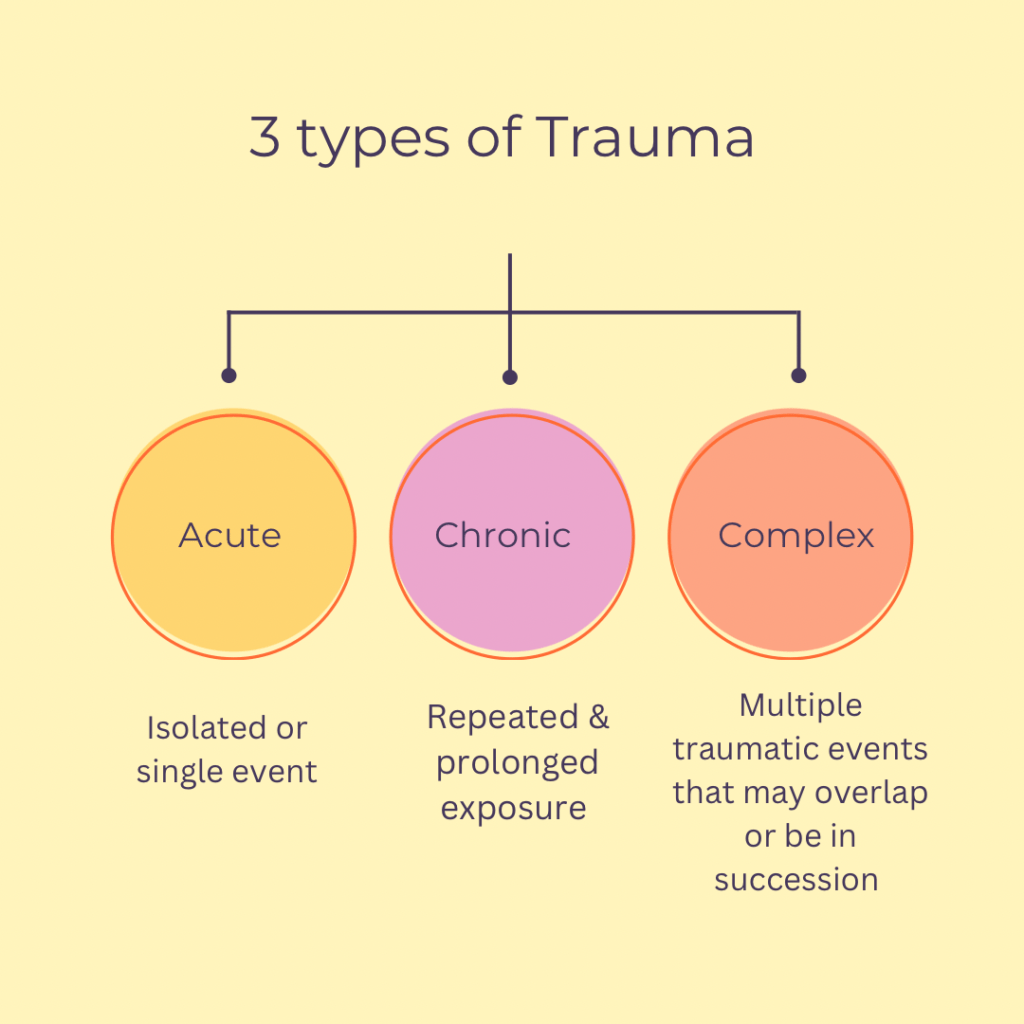
An individual can experience:

  1. Acute Trauma – this type of trauma occurs as the result of an isolated, terrifying incident where a person feels overwhelmed by a direct threat to their life or someone else’s and has feelings of intense helplessness and fear. Some examples where acute trauma may occur are: witnessing an act of violence, death of a loved one or seeing someone die, living through a traumatic situation like a car accident, house fire, natural disaster, etc.

2. Chronic Trauma – this type of trauma describes a situation where a person experiences many traumatic events over an extended period of time, such as in cases of repeated exposure to abuse, neglect, domestic violence, those who live in war zones or areas of severe political unrest. The repetitive nature of this type of trauma causes a person to develop significant loss of trust in other human beings, anxiety and fear for their own safety, guilt, shame and symptoms such as chronic anxiety, physical or mental illness, addiction and fatigue.

3. Complex Developmental Trauma – the third type of trauma is the one that is most important to understand in light of foster care. Developmental Trauma is diagnosed by four significant factors. First, it includes traumatic events early in a child’s life (the first five years). Secondly, it includes patterns of chronic, ongoing trauma. Thirdly, it involves maltreatment of some kind such as abuse or neglect and fourthly it includes the absence of a caregiver to protect or buffer the traumatic experience. Oftentimes, this trauma occurs at the hands of the very person the child should be able to rely on to protect and support them such as a parent or other trusted adult.

While all three types of trauma are certainly impactful and devastating, Complex Developmental Trauma often has long lasting and severe impacts that are very important to understand.

Photo by Lisa from Pexels on Pexels.com

When parenting a child who has experienced this type of trauma, it is essential to focus on helping the child feel connected and safe with their caregiver. This is no small feat. The child who has experienced complex developmental trauma will most likely experience developmental delays, cognitive deficits, physical and mental fragility and illness, challenging emotions and behaviours and resistance to both structure and nurture.

Many times, these symptoms of trauma look a lot like bad behaviour. If we have not taken the time to get curious about the ways children are behaving and responding, we risk causing further hurt to the very children we want to protect and care for.

Initially in our foster care journey, my husband and I had a very limited understanding of trauma and its impacts. As the years went by, we started realizing how small our “toolbox” was and we were noticing that some of the traditional parenting techniques we relied on were not having the effects we anticipated. Removing priviledges, time outs, consequences we felt fit the behaviour, punishments…they did not seem to sit the same with these kids. We knew that we needed a greater understanding and compassion for what was going on inside of these children’s minds and hearts. We wanted them to experience healing and connection.

I am so grateful that God gave us opportunities to learn more about how trauma impacts a child and what that meant for us as their caregivers.

More importantly, it’s changed the way that I view the world and the people around me.

Slowly, I am learning to ask,

“What happened to you?”

Instead of,

“What is wrong with you?”

Dr. Bruce Perry and Oprah Winfrey wrote a beautiful book titled What Happened to You? In it, they explore this exact shift and what it might do to promote healing in our society if we all learned to ask this question.

I am also learning how to be curious instead of furious about challenging behaviours and responses – both with my children and myself! I am learning how to put on a lens that assumes this person can’t yet instead of won’t. This mindset assumes that people are doing the best they can with what they have and that skills can be taught through care and connection.

Dr. Ross Greene has become popular among child phsychologists and educators with his Reframe the Behaviour model. I have this infographic posted on my fridge because I need the reminder every single day.

“Kids do well if they can.” – Ross Greene

No child (or adult) sets themselves up to fail. We all want to thrive and succeed, but sometimes there are expectations, requirements or assumptions placed upon us that are not appropriate for our mental, emotional or cognitive capacity.

“See a child differently, you see a different child.”

– Dr. Stuart Shanker

So why all the talk about trauma?

Understanding trauma helps us to move from simply feeling compassion to truly developing the skills needed to care well for those who have lived through horrific experiences.

Photo by Pavel Danilyuk on Pexels.com

Maya Angelou was a poet and civil rights activist. She once said,

“Do the best you can until you know better. Then when you know better, do better.”

 In chapter 3 of his letter, Paul writes to the Colossian believers about their new identity in Christ.

“Put on then, as God’s chosen ones, holy and beloved, compassionate hearts, kindness, humility, meekness, and patience, bearing with one another and, if one has a complaint against another, forgiving each other; as the Lord has forgiven you, so you also must forgive. And above all these put on love, which binds everything together in perfect harmony. And let the peace of Christ rule in your hearts.”

Compassion and kindness.

Humility.

Meekness – strength under control.

Patience and forgiveness.

These are the characteristics that are to mark the believer.

Similiarly, to the Phillipians, Paul encourages them,

“Do nothing from selfish ambition or conceit, but in humility count others more significant than yourselves. Let each of you look not only to his own interests, but also to the interests of others.”

If there is anything I have learned in this foster care journey, it is that humility is the most important ingredient.

It takes humility to consider new perspectives, to lay aside preconcieved ideas and to admit when my repetoire is limited and lacking.

Neuroscientific research is exploding with new information about how our brains and bodies are designed to respond to the world around us. Everything I have learned about trauma is consistent with what the Bible teaches about how we were created and who we were created for.

There is so much hope and healing available, but it begins with a deep understanding and acknowledgment of brokenness.

I am passionate in helping everyone everywhere, but especially those who are Christians, understand more about trauma and how it impacts those who experience it because I believe that this is the way that Jesus would have us live and walk in the world.

Love God.

Love people.

This is why trauma matters.

-AF

Statistics

May is foster care awareness month.

My goal this month is to post in some medium on a daily basis to create greater awareness of needs, dispel some myths and encourage those impacted by foster care.

I’d be so delighted if you are able to join me this month. Additionally, if anything I say sparks curiosity, resonates with you or inspires you, please take the time to share that in some way with someone in your life.

It takes a community to care, to create lasting change and to build support around the vulnerable. It all begins with a conversation.

May 2: The Statistics

“Without knowledge, action is useless; and knowledge without action is futile.”

-Abu Bakr

According to the Ontario Association of Children’s Aid Societies, in 2024 there were an average of 8200 children and youth in care in Ontario each month. Over half (56%) of those were youths aged *16-22+.

Every region in Ontario is in desperate need of more foster homes in order to be able to place these children in safe, loving environments while the agency works with the caregivers to try to increase safety and well being. Many children are needing to be moved far from their home, family, school and services to be placed in a foster home. This makes the process of supporting and reunifying the family unit much more challenging. It also increases the traumatic impact on the child and the losses they incur during that separation process.

Poidata states that there are 4 841 churches in Ontario. When we compare this to the average 8200 children in care each month, this means that if each church in Ontario cared for just two children in care, there would be more than enough homes for the 1% of children who are removed from their families and in need of a safe place to stay.

So how do these families become connected to a child welfare agency?

Most of these families will get connected throuh referrals from concerned individuals such as teachers, neighbours, family members or friends. Some referrals are made by police or other public service agencies.

Everyone in Ontario, including general citizens and people who work closely with children, are required by law to report suspected child abuse or neglect of a child under the age of 16 to your local child welfare agency. While this may feel like a difficult decision, it’s always best to ere on the side of caution and allow professionals to decide whether or not your concerns are in need of further investigation.

More than 125 000 calls or referrals requesting family assistance were made in Ontario in the 2023-2024 fiscal year.

Out of these, 63 000 (just under half) required a full child protection investigation. The rest of these referrals did not require a full investigation and/or were connected with community resources that would further equip and proactively offer protection.

Photo by Photo By: Kaboompics.com on Pexels.com

When a full investigation was completed,

  • 97% resulted in children and youth remaining at home with their families while agencies work alongside to offer support and buffering care
  • A mere 2% of those investigations resulted in a child needing to be removed from their home and placed within the home of a family member, friend, neighbour, etc.
  • Only 1% of those investigations resulted in a child or youth being removed from their home and placed into foster care

Child Welfare systems are overwhelmed, undersupported, working with minimal resources and surrounded by legal “red tape” that governs their ability to provide services and protection to children and families. Despite that, they are working diligently to provide support to families that will enable them to keep children at home with their parents. This might look like finding funding, respite or educational opportunities for caregivers. It may also include assistance for parents in navigating challenging systems and connecting them with community supports. It might look like offering 1:1 parenting coaching, group parenting classes or connecting parents with services needed.

Child Protection Workers work hard to find creative, supportive and respectful ways to support struggling families.

Contrary to popular opinion, children are not taken from families lightly and child welfare agencies certainly are not interested in removing children without proof of significant danger and only after many attempts have been made to remediate the situation in other ways.

So what can we do about these statistics?

  1. Pray – Offering support to hurting, vulnerable and broken families requires much grace and wisdom. Pray for the families, youth and children represented by these statistics. Pray for the social workers and agencies on the front lines attempting to offer support to these families. Pray for families currently offering care to these children and pray that more families will step into the gap to fill these needs. Pray for churches to get involved – that as Jesus followers we would be willing to bridge the gap between child welfare agencies and Christians who are eager to care. Pray for the hands and feet of Jesus to be evident in Ontario’s foster care system in undeniable ways.

35 For I was hungry and you gave me food, I was thirsty and you gave me drink, I was a stranger and you welcomed me, 36 I was naked and you clothed me, I was sick and you visited me, I was in prison and you came to me.’ 37 Then the righteous will answer him, saying, ‘Lord, when did we see you hungry and feed you, or thirsty and give you drink? 38 And when did we see you a stranger and welcome you, or naked and clothe you? 39 And when did we see you sick or in prison and visit you?’ 40 And the King will answer them, ‘Truly, I say to you, as you did it to one of the least of these my brothers,[a] you did it to me.’”

Matthew 25:35-40

2. Start the Conversation – Whether this is at your dinner table tonight, in your weekly small group, your workplace or with your neighbours…start a conversation that is both factual and compassionate. The way we speak about foster care and the people within this system matters. Talk to your spouse about how you might be able to get involved as a family. Talk to your teens about the reality that many of their peers are living in. Talk to your kids about why a child at school might be having a hard time and how not all families look the same. Talk to the people in your church about how you might be able to offer care to those in your community who are struggling. Talk to foster, adoptive, kinship and customary care families about their experiences and ask how you might be able to offer support to them.

Above all, love each other deeply, because love covers over a multitude of sins.”

-1 Peter 4:8

3. Act – Lastly, however you are prompted by the Spirit – take action. Make a phone call to your local foster care agency or a family you know who is providing foster care. Make a plan for how you are going to support a foster family or how you might be able to help support a struggling family. Continue to educate yourself about how foster care is impacting your community and what efforts are being made to alleviate risk factors.

Thank you for caring!

-AF

*Did you know that child welfare agencies provide supports to youth “aging out” of the system up to the age of 22 and even older? There are myriads of ways you can support these young adults in your community.

Some practical needs include: housing in the form of an extra room to rent out to a youth attempting independence or lacking family support, providing transportation, mentorship opportunities, etc.

Think of all the things you didn’t know at age 18, 20 or 22. College applications, healthcare, employment opportunities…all of these are huge and scary realities that a teen emerging from foster care or a dysfunctional family environment may need support navigating.

Let’s Begin With Loss

May is foster care awareness month.

My goal this month is to post in some medium on a daily basis to create greater awareness of needs, dispel some myths and encourage those impacted by foster care.

I’d be so delighted if you are able to join me this month. Additionally, if anything I say sparks curiosity, resonates with you or inspires you, please take the time to share that in some way with someone in your life.

It takes a community to care, to create lasting change and to build support around the vulnerable. It all begins with a conversation.

Photo by Alexander Krivitskiy on Pexels.com

May 1: Let’s Begin With Loss

Every single child who enters the foster care system has experienced significant loss. By this I mean they have experienced gut-wrenching, world shifting losses that will forever change how they view the world. We call this kind of loss: trauma.

Typically, these losses include:

  • Loss of a parent or other primary caregiver through separation or death
  • Loss of extended family members and friends
  • Loss of familiar environments such as their school, daycare, favourite park, neighbourhood, etc
  • Loss of toys and items – that stuffie he always sleeps with or the markers Grandma gave her for her birthday are likely to have been left behind
  • Loss of safety – children are only ever removed from homes because they are in need of safety and protection in some form
  • Loss of comfort – whatever is normal to us is what we find comfortable. While a blanket reeking of marijuana may not provide comfort to you, for a small child who associates this smell with “home”, replacing that blanket or washing it with bleach to remove the scent you find disgusting will be a loss.
  • Loss of control – children almost always enter foster care against their will.

These kinds of losses accumulate in staggering realities when a child is removed from their home and family and placed into foster care. This choice is never made lightly. It’s important to remember why this move is deemed a last resort intervention for families who are struggling and the impacts this intervention will have on the family unit.

In the face of such significant losses, most children and their parents will experience feelings of grief, anger, hopelessness and shame.

But this is not what most people first think of when they see a child in the care of a foster family.

“Adoption (or foster care) loss is the only trauma in the world where the victims are expected by the whole of society to be grateful.”

-The Reverend Keith C. Griffith

This quote popped up on my social media feed recently and snagged my attention long enough for me to wince. I feel this. As a foster mom who has loved the children that enter my home deeply, advocated intentionally for their needs, been proactive about connecting with biological parents in healthy ways and supporting reunification…I still fall into the trap of believing that these children and families I care for should be grateful to me; that they owe me something.

This theory is reinforced through comments, conversations and stories that celebrate foster parents as heroic, “saint-like” humans with special giftings to care and serve well. Simultaneously, biological families are generally viewed with thinly veiled disdain and suspicion.

I cannot count the times I have shared that I am a foster parent and been told,

“Good for you!”

“You are amazing!”

“I could never do that.”

“They are so lucky to have you.”

I’m a human, and sometimes these comments feel really good! However, that feeling of satisfaction or even pride is always followed by a sense of sadness, discouragement and a feeling of being misunderstood. While I do understand these comments are made with the best of intentions, they all play skillfully into this false perception that foster parents are uniquely equipped humans who have chosen to sacrifice greatly for the good of others – others being children and families in need of our rescue.

So what’s the problem?

The problem is that when people are hurting, they don’t need someone to rescue them. They need someone to care. And almost anyone can care!

Until we can see foster care as a way to care instead of a way to rescue, we’re going to keep getting it wrong and having unrealistic expectations.

The mother with addiction issues needs someone to care enough to ask the question, “What is it in life that feels so big that you’re reaching for these negative coping tools right now?”

The father with domestic violence charges needs someone to care. Someone to say, “I get it. I never knew I could feel rage toward someone I loved until I became a parent. I know you love your kids. Let’s figure out how to break the patterns of anger and violence so your kids can feel safe with you.”

The toddler who has just been placed into a stranger’s home, far from everything familiar in life, needs someone to care. He needs someone to be patient as he screams through bathtime, bedtime and storytime.

The grandmother who is “abandoning” her grandchildren needs someone to care. She needs someone to come alongside and say, “How can I help? This is a lot that you’re carrying, and I can see how exhausted you are. Your needs matter too. “

The adolescent who has just entered foster care against her will needs someone to care; someone to give her choices about as many things as possible as she navigates this new life that she did not choose or want or ask for. She needs someone to be curious about the coping tools she’s accumulated to survive in a challenging home environment. She needs someone who is willing to show up again and again and again and again.

And all these people need someone who is willing to care without expecting gratitude in return.

I have never met a parent who does not genuinely love their child and want to do better, no matter what they have done. I have also never met a parent who gets it all right 100% of the time.

Almost all of the parents of children entering the foster care system are people who have experienced trauma. They are coping with life in the only ways they know how…just like you and I. Many of them grew up in foster care themselves or in abusive or neglectful home environments where they did not get a chance to learn how to care for children or themselves as caregivers with a healthy balance of structure and nurture.

Many of them are isolated, struggling with mental illness, have toxic relationships and lack financial security.

What would it look like to change our understanding of foster care to include more empathy surrounding the losses involved?

My hypothesis is this:

Understanding the losses that children experience when they enter the foster care system would lead to communities who are:

  • more empathetic toward children in foster care and their biological families
  • more proactive about suppporting struggling families
  • curious about behaviors of both children and adults within the system who have experienced loss
  • dedicated to preventing the separation of families and supporting the reunification of families whenever possible

One more thought to leave you with.

What is something in your life that you do not like and cannot change?

What emotions, behaviors and coping tools come to the surface as you process that reality?

What might it look like to support someone involved with the foster care system today with empathy, curiosity and care?

-AF

Simplifying Childhood

Moving our family to a little falling down farm on the edge of town has been an adventure in so many ways.

This move was birthed out of a myriad of desires, passions and ambitions.

One of those was the desire to give our children the gift of a simplistic childhood.

I grew up on a dairy farm in Wellington County where I spent my summers crawling over straw bales, running barefoot through the yard, nestling fluffy kitten fur up against my cheek, climbing trees, eating apples plucked from our orchard and wading through muddy creeks.

I had no idea how magnificent this childhood experience was or how much texture and depth these experiences added to my life.

I didn’t know that I was learning to take risks as I rode my bike down the barn steps and balanced precariously upon barn top beams, determined to keep up to my older siblings and cousins.

I didn’t know that the wide variety of sensory experiences were contributing to brain development as I felt mud between my toes, rocks beneath my calloused feet and dirt under my hands.

I took for granted the way I could walk out the doors and roam free for hours, with no specific goal or destination in mind, just freedom to be and explore my world as I wished.

Every summer my skin would turn brown beneath the sun’s warmth, my dark hair deepening to hues of auburn and chestnut.

I thought it was normal for children to sit high in the branches of a pine, bare legs swinging, to make forts in the barn loft or catch frogs in the pond.

As I grew and left my childhood behind, I left many of these simple pleasures with it.

Now, I look at my children and I would give anything to be able to give them a taste of the life I once lived. Not only because of my own fond memories but because the more I learn, the more I realize that this kind of environment nurtures healthy, happy children.

Children are meant to be able to learn and explore and fall and laugh. They are meant to experience freedom and follow their curiosity and dig through the layers of a richly textured world.

So how do we do this?

How do we give our children the gift of simplicity, setting them free from the demands of a society who would want to categorize them, sit them down, mold them into tiny adults?

  1. Let them play. They are little for such a short time, and for some reason we feel we need to organize them; sort them into categories, grade their achievements, nudge them toward accuracy and reality. But children have rich, creative minds. They see the world differently. Good and evil stand in stark contrast, and they will recreate this in their play. Every little bug in the dirt or tattered leaf or knobby stick can be studied, delighted in and recognized to be something magnificent. Give your children space to play freely. Do not fill their time or their rooms with too many toys that will entertain them and tell them what they should do and how they should do it. Instead, give them a bucket of plain wooden blocks. Dump out a bin of Lego builders. Leave some paper, crayons, glue and scissors on the table and see what they create. When they bring you their stories and structures and collections, admire them for what they are. Ask them questions and let them decide what they have created, don’t assume or pass judgment.
  2. Give them structure. This may seem contradictory to play, but really it is what makes the play possible at all. Children thrive when they are surrounded by comforting absolutes. Too many variables make children, especially young children, feel vulnerable and unsure therefore discouraging them from following their naturally inquisitive minds because they are too busy worrying about what they might need or miss. Predictable meal times and bed time routines are essential and create a rhythm to your days that wraps them in security and comfort. Knowing what to expect their days will look like, generally of course, helps children to relax inside those parameters and busy themselves with the great work of childhood…play. Children who feel safe can explore and create and learn.
  3. Take them outside. Snow, rain, sun, sleet…let them experience it all. Nature is full of endless entertainment for children. Mud puddles, trees to climb, birds nests, caterpillars, water, ice and dirt. Invest in mud suits, rubber boots, warm clothes and ratty old jeans that you won’t mind getting torn and ripped. Give them shovels, containers, watering cans and buckets. Go for walks both on sidewalks and off; a walk to the park and a hike through the bush can be equally exciting for a child. Let them get messy; let them take risks, even fall down and hurt themselves every now and again. Eat outside, read outside, play outside and even nap outside. Go to the beach, the park, the forest, the farm, the backyard. Build a sandbox, set up a bucket of water or a plastic pool, ride bikes, blow bubbles, go barefoot. All these experiences feed the soul of a child. Not only will this environment be beneficial to their brain health but it will also give them the best chance at being healthy emotionally and spiritually.
  4. Give them rest. This includes physical, emotional and mental rest. Create a solid, dependable, practical bedtime/nap time routine and stick to it. Kids need plenty of sleep. In fact, ironically it seems the more sleep they get the more sleep they need. Tired kids will have a hard time playing or resting well. Try to balance your day with both active and restful activities. For example, an hour or two of outside time might be followed up with some stories on the couch. Playing play dough might precede going to the grocery store or some other outing that is more chaotic. If older kids complain of being bored, don’t become too anxious about filling that space for them. It’s necessary for them to learn how to enjoy their own company and not be afraid of the quiet. Teach them how to be able to sit and look at books, to be still and watch a tiny ant carrying his disproportionate load, to breathe in deeply in and out and feel their muscles relax from head to toe. Surround them with quietness, peace and stillness regularly.
  5. Involve them in responsibilities. Kids love to help when they feel they are wanted and needed. There is nothing that can replace the pride of knowing you have done a job well. Provide plenty of opportunities to work both alongside you and independently. Participating in family chores fosters responsibility, healthy self image and gratitude. Teach them to cook and do laundry. Don’t shy away when they sigh at being told once again to unload the dishwasher or help set the table. Praise them for jobs well done and send them back to redo jobs done haphazardly. Will they thank you down the road? Probably not. But that is beside the point. They are learning they are a part of something. They are seeing the real life in front of them and will start to notice what others around them are doing. You will know you are on your way when they thank you for doing their laundry, unloading the dishwasher or picking up their scattered shoes.                    

Children need so much from us, and yet so little. They require huge quantities of our emotional and physical presence with them but they require so few resources to truly grow and thrive.

We cannot travel the world today and give their little eyes the sights of the Great Wall of China, the Eiffel Tower, the Grand Canyon and and Cliffs of Moher…but we can go outside and see the birds and feel the mud under our rubber boots and watch our chickens peck away at the rinds of a cantaloupe.

We cannot afford private music lessons to entice their musical little minds toward Mozart greatness, but we can turn on some nursery rhymes and beat to the rhythm on our homemade drums.

My preschoolers are at home with me. They do not play in sensory buckets every day, practice lining up at the door, learn rhymes and riddles for every activity or get exposure to early learning curriculum….but I can let them help me bake muffins, teach them how to zip their jackets, sit on the floor and build towers of blocks with them or read them story after story.

Reminding my mother heart of these time-proven child raising truths has helped me to refocus my parenting on what is most important. When I fall into despair because I cannot possibly do it all, I can come back to this and remind myself of what I can do today that is valuable.

-AF

Self Care and Why it Matters

I remember the first time I travelled internationally with my children.

For the first time I actually stopped to listen and observe carefully as the flight attendants demonstrated how to use the oxygen masks and life vests in case of an emergency.

With my baby in my arms and two daughters beside me, it suddenly felt important to know how I would go about saving their lives if need be.

The most important take-away?

Always put your own mask on first.

It struck me how contradictory this was to every maternal instinct inside of me.

As mothers, we regularly play the martyr.

We sacrifice.

We shield.

We protect.

It’s who we are, and who we want to be.

But what happens when the steady pouring out of ourselves leaves a gaping hole?

What happens when the mundane of life covers up the joy?

Is it ever ok to put me first?

As Christian mamas we heap on the added burdens of selfless service, taking up our cross and putting others ahead of ourselves.

We take the verses to heart and stretch ourselves thin and fragile over our treasures.

We want it all.

We want to be enough.

But we foolishly forget we will never be enough on our own.

There is no glory in exhausting our own resources so that at the end of the day we are weary, discouraged women with nothing left to offer.

I realize there are seasons and days when this is the inescapable reality of motherhood.

We all have seasons that drain the life out of us, but sometimes it’s because we are neglecting our own souls.

Self care is a bit of a hot button word right now, but it’s really not that complicated.

It means taking time to infuse hope, joy and energy back into myself.

The purpose of self care is to fill yourself up so that you can once again pour yourself out.

It’s hard to mother well from a depleted soul.

I practise self care so I can tuck my children in with smiles and tender kisses at the end of the day.

I practise self care so that I have energy to be active with my children.

I practise self care so that I reflect hope and joy to a dying world around me.

I practise self care to remind myself of who I am in Christ.

I practise self care so that I can enjoy time with my husband.

If you’re like me you might be reading this thinking, “Great, another thing to add to my never ending to do list.  One more thing I’ve neglected to accomplish.”

But self care is probably something you’re already doing…it maybe just needs to be prioritized into your life a little more intentionally.

Self care is doing things that you love; things that make you happy.

It means feeding your passions and pursuing your dreams.

It means disciplining yourself to choose what is best so that you can reach your very greatest potential.

It means that every now and then, you put your own spiritual, emotional or social needs first.

So today…find a way to take care of yourself.

Turn on your favourite music, order pizza for dinner or get out for a walk.

Take a bath…with music so you won’t hear the chaos the kids are causing downstairs with your husband.

Plan a date night at home, exercise or go shopping.

Take a nap while the kids lie down, join a women’s group or book club, journal or call a friend.

Change the scenery around you for a few hours.

When we think of self care we tend to think of hiding away in a corner somewhere by ourselves, but some of these things can be done with your children at your side.

It’s about choosing to enjoy the life you have, and finding ways to make it easy to enjoy.

It’s ok to leave the dishes for a nap sometimes.

Deciding to spend the morning outside in the sunshine instead of cleaning the house is not a choice you will regret.

Losing some weight or cooking a nutritious meal will help you feel more motivated, energetic and happy.

Listening to your favourite worship songs while you feed the kids breakfast could be the difference between staying calm and refreshed or frustrated and stressed through the morning rush.

Pick up your Bible while the kids are quiet or listen to your favourite podcast while you fold the laundry.

I have found it can be such a subtle change to my day but such a great shift in my heart when I take the time to choose things that will fill up my own cup.


In John chapter 10 Jesus says,

“The thief comes to steal, kill and destroy but I came that they may have life, and have it abundantly.”

This is what Jesus desires for you.

Life!

Abundantly.

~AF


This One’s for the Moms

Parenting is hard work.

Nobody is perfect but somehow we still expect perfection, especially from ourselves.

It doesn’t help that we have access to so much information.

Every day we as moms are bombarded with hundreds of messages of what we should and shouldn’t be doing, wearing, saying and eating.

Sometimes I feel like no matter what I do, it’s never enough.

How do I know if I’m doing this well?

What are the most important things?

Am I getting it right?

IMG_9985-13
Enter a caption

But God gave those children to you for a reason, Mama.

The best parenting moments often happen when we are confidently parenting in the ways that we instinctively know are best for us and our children.

Here are a collection of some things I have told myself and other moms.

Because we could all use some grace.

***

Dear Moms,

Your child will not die if they eat Kraft Dinner tonight…or three times this week.

Your integrity as a person does not depend on the cleanliness of your home.

It is ok not to breastfeed your baby.

Not all immunizations are good and not all are bad.  It’s ok to make your own choices and its ok to just follow the immunization schedule your doctor suggests.

Colds and flus happen and there is very little you can do to stop them.  They will run their course and be over soon.

Some of the best days happen in pajamas with unwashed faces, bare feet and dirty floors.

IMG_4866-81

Having devotions every day is not always possible when you are a mom.  You are not going to hell for being busy caring for the little people He entrusted to you.

Sometimes your child will be the bully and other mothers will misunderstand you and yours.  Take it as an opportunity to develop character in yourself and your child…and remember in detail all the times you were mean to others as a kid.

Most children do not enjoy church.  This doesn’t mean they will never be Believers, it just means they’re regular children.

Sleeping through the night for babies, toddlers and mothers is a myth.  Few nights will go by that both you and all your children will sleep for 8 hours with no interruptions.  Lower your expectations and you will all be happier.

Sometimes bribes are the perfect solution.

Don’t turn everything into a lesson.

Babies cannot be spoiled by being held…but it’s also ok to put them down so you can take a shower.

You don’t always have to give a reason other than “Because I’m the mom.”

Co-sleeping can be wonderful…or terrible.  It really is YOUR choice.

Follow your instincts…but don’t expect to be a super-human.  You never did or will know everything about everything.  Sometimes it’s better to call the Doctor.

Pretending you did not hear or see something is a coping mechanism every parent will use sometimes.  Stay sane!

Siblings will fight, and sometimes they will hurt each other.  This is normal.

096_IMG_5156

Every parent does hundreds of things they will later regret.  Say sorry, do what you can to resolve the situation and then move on.

When the dentist says your child has cavities it does not necessarily mean that you are not brushing your child’s teeth well enough or often enough.  Also, no one expects you to have time to brush and floss three kids’ teeth for them every morning and night.

Living off the grid and growing your own food is probably not a good option for most of you.

Whichever way you choose to educate your child has worked for hundreds of other children on the planet.

DIY sometimes just means that it looks like you did it yourself.  Don’t let Pinterest fool you!

pexels-photo-159984


Love really does cover a multitude of sins.

The TV is a good babysitter and its ok to use it some days.  If it provides you with the breather you need then it is probably worth it.

Children under 5 rarely handle social situations well.  They hit, they bite, they scream and they grab.  This is perfectly normal.

Sometimes you need to put your own needs ahead of your children’s and practise some self care.  Don’t be a martyr.

No matter how hard you try, there will be some things you do badly.

It’s okay if you’re aiming for just OK.

Life is not fair, and your kids should know that.

Children love time with you.  It doesn’t always have to be quality, it doesn’t always have to be quantity.  Both have value and significance.

Your kids will not always be happy and they will not always like you.  That doesn’t mean you’re doing anything wrong.

It’s ok to say no.  It’s also ok to say yes sometimes.

Adolescents will be grumpy a lot.

You will not enjoy your children, or parenting, all the time.

God loves to fill in the gaps that we miss as parents with His perfect, extravagant, more than enough love.

042_IMG_4883

Keep your chin up and your smile on.

You.

Are.

Doing

Great.

With Love and Grace,

Another Imperfect Mom

~AF

*Photography credits to Unfrozen Photography


Life Unexpected

It is the stuff of nightmares.

A doctor with an apologetic face;

He’s offering a chair, taking a deep breath…

Brain tumour.

My heart clutches.

I look to my husband and I see his face cringe.

Our son snuggles closer between us when we cling and sob out sorrow.

I race home to collect a bag of things,

To hug my girls good-bye.

Their fear and innocence in contrast pushes me on.

I promise them and hold them tight.

Before I can breathe,

process,

hold this new reality in my hands…

We are being rushed toward the helicopter, my tiny son strapped to a stretcher and crying as we roll through the darkness.

I’m kissing my husband goodbye.

“I will be there as fast as I can.”

I want to scream,

To pull my baby in my arms and run far away from all this.

The men are large and strangely comforting in their neon jackets.

They are gentle and calm.

They strap us in and sit quietly in my stunned grief as we fly through the night sky.

My son settles into an exhausted sleep and I hold his hand and stare down at the lights below.

Steadfast love.

It comes to me and pulls together my anguished heart.

Over and over in the last 2 weeks I was drawn to the psalm, not sure why, and now the words bind up my wounds.

“Your steadfast love, O Lord; extends to the heavens, your faithfulness to the clouds.”

“How precious is your steadfast love, O God!”

“Let your steadfast love, O Lord, be upon us, even as we hope in you.”

Steadfast.

Love.

I breathe and take refuge in the angels in neon across from me.

We are landing and they place him back in my arms.  I hold him close and wrap a blanket around his bare arms.  We’ve left without a jacket and the night air is cold.  I grip him to my heart and try to transfer myself to him.  I know he is afraid.

Steadfast love.

We follow strange corridors and crowd into an elevator.  The men in neon surround us and tower over us.  My son gazes wide eyed and scared.

We follow back outside to an ambulance and whisk away.

I breathe gratitude and feel tears well when they allow me to hold him instead of strap him to the stretcher.

We are sitting in a busy hallway on a stacking chair being admitted and still I hold him tight to my chest, the blanket securing him to me.

My eyes feel big and scared.  I feel small and unsure.

My heart flows gratitude when I see my big brother round the corner and come to us.

He stays with us even with his own son lying upstairs.

Steadfast love.

The hours blur as they insert IVs, put on lead lines and watch monitors.

My baby’s skin has always been so spotless and white.

I cringe as they pin him down and poke and press.

He is terrified.

My husband comes and we sit together in shock as our baby drifts to sleep on the cold white hospital bed.

Questions.

Answers?

My phone dies from the texting.

We spend the night in a crowded room trying to sleep in the upright hospital chairs.

We won’t leave him.

He falls into sleep and I am so thankful he can escape this nightmare as I try to get comfortable.

The next day there are tests.

More questions.

Information staggers my mind and makes me stare at my boy unbelieving.

So perfect.

So unblemished.

So innocent.

Brain surgery tomorrow.

9am.

They will cut his scalp open and drill a passage way through his brain.

I hold the words at arms length and turn my eyes so I won’t have to look too close, to let the terror seep in.

I focus on reassuring my toddler, learning new terms and piecing together brain anatomy.

I phone my girls and once again I put on my brave voice.  I am their string of hope and I won’t let them down.

My voice is strong and sure as I promise them and reach for words they can understand.

I give them just enough to ease their anxiety, but not too much.

We take our little boy, clad in hospital gown and pajama pants, to the play room.  For over an hour he plays and we watch him forget about the IV on his arm.  He babbles and laughs and points at the elevators moving up and down.

Steadfast love.

I wonder when he will play again.

That night I sleep on a couch near his room, comforted by knowing that I will be close by if he needs me.

Morning.

Surgery day.

Only now do I let myself Google it…preparing my heart for the fall.  The words I find give me footholds of reassurance and I claim them fiercely.

My husband carries him through the halls to the OR.

We look at books and try to hide our uncertain tears from his little face as we wait.

He likes the trucks and tractors in the book.

For a minute he goes very soft in my arms and snuggles up to my neck.  I squeeze him close and breathe him in.

Steadfast love.

When they take him and his bunny Flopsy away he cries and we force ourselves to turn and walk away.

My mother in law’s arms give me a second to collapse and I feel tears rush in.  She holds my pain for a minute before letting go and it feels good to share a bit.

It is 6 long hours.

I am nervous…but I also feel held.

I am humbled as I realize all the people praying in this moment.

I believe.

Steadfast love.

The surgeon is there.  I anxiously rise to the inevitable and scan his face for hope.

He is so pleased.

Gratitude overwhelms as he describes what we hardly dared hope for.

It is gone.  They’ve gotten every piece they could find.

Steadfast love.

We go in to see him and I could weep with relief.  His chubby cheeks relax in peaceful sleep.  Flopsy is still there with him and we tuck him up by his arm.

Steadfast love.

The uncertainties lurk but we hold onto the hope and embrace it.

Its been a few days now and I sit by my baby’s bedside in the ICU.

The adrenaline rush is collapsing and the truth feels cold and hard beneath my tumbling heart.  I am scared and uncertain in this new reality but still…

Steadfast love.

I reach for the hearts that I know will hold me, us, in all our pain.

He is seizing beneath my trembling hands and his eyes stare dull and lifeless.

They are rushing in, grabbing masks, calling code.

I am being pushed back from his bedside and I cling to my husband’s trembling chest.  More and more…they just keep coming, calling out orders and stats.

I am terrified and the sobs push out of my lips.

I stumble out into the hallway into the waiting arms of my sister in law, who came rushing when she heard the code.

She holds me and says “I’m sorry” as I fall apart.

I know she knows this feeling and I am so grateful for her presence in this moment.

He knew that I would need her tonight and her son is surprisingly, blessedly, fast asleep down one floor in his room.

Steadfast love.

We return to the ICU and I am so grateful.  The carefully monitored room feels familiar and safe after the last 24 hours.

Answers come and we nod in understanding as they explain.

Knowledge gives grip to confidence and I advocate for my son, feeling strong and sure in the normalcy of knowing what is best for him.

Steadfast love.

It’s painful to watch him grasp for strength and my heart staggers under the weight of discouragement.

She knows me well and despite my efforts her arms bring the tears flowing.  It feels better than I thought to let the fear out and fall apart.

Steadfast love.

He meets us on the street corner with the kindest and gentlest of words.

“Don’t worry,” he tells my husband, and we see he really means it.  He gives generously and my eyes fill once again with gratitude for this man who has continually blessed our family again and again and again.

I am humbled and so grateful.

Steadfast love.

The waited on words are offered casually and its anticlimactic as we cautiously grasp hope.

No cancer.

No further treatments needed.

“I see no reason he should not have a full recovery.”

Really?!

Steadfast love.

A weight falls off our shoulders and breath comes easier.

For the first time in days I see light.

I wake up to the video and I smile the biggest smile.  It’s my little boy grinning his crooked little smile and high fiving Daddy with his right hand!  The side that’s been weakened since surgery.

Steadfast love.

So much joy with one small milestone!

They keep coming and coming.

First kick,

first reach,

first grasp of my finger,

first step,

first bite.

So many reasons to be grateful.

Steadfast love.

I talk to them on the phone and they are bubbling over with happiness and news.

“I miss you, Mommy.”

“I miss you, too.”

And then she goes on with what Nana said, what Papa did, what happened at school…

I smile the biggest smile as I listen to her happy voice.

They are safe and happy, even though they are so far from me.

They have found their people and they know who they belong with right now.

How do we deserve to be loved so unconditionally and fully?

Steadfast love.

It’s our first weekend home!

We get a pass!

I am ecstatic and my heart actually skips a beat as we drive into our small town.

It’s so beautiful and green everywhere!

We’ve been gone a month and so much has changed.

Life everywhere.

I drink in the green trees, the breeze on my face as it blows off the bay, the sight of my children all playing together in the back yard.

Steadfast love.

Life has changed, and I miss the way it used to be.

But in it all, I am so grateful.

And I know…

In the journey there is beauty,

growth,

redemption,

and always…

Steadfast love.

-AF


Adoption vs. Birth

I went into adoption absolutely certain that I could and would love children born to another woman.

I was right.

I knew long before I met my girls that my love could run as deep, steady and strong for a child I chose through adoption as a child I gave birth to.

But there was also a lot I didn’t understand until I gave birth to my son.

Before we adopted I naively thought that love for my daughters would come instantly and feel deeply maternal.

I was wrong.

While I did fall instantly in love with my daughters, it was a very different kind of love than the love I felt when I gave birth to my son a  year and a half later.

It took day in, day out, month after month after long month of choosing to love my daughters before those feelings of natural, instinctive, maternal love came to me.

In theory I loved them fully and intimately, but realistically

we were strangers

and we needed to get to know each other.

I hadn’t spent nine months feeling the stirrings under my heart.  I hadn’t held them for those first breaths and watched each tiny movement.  I hadn’t witnessed the steady growth and development and learned what experiences formed in them their character and who they had become.

I have missed so much and I grieve that deeply.

When my son was born his innocence and purity took my breath away.  He was…and still is…so unscarred by this world.

My daughters never had that experience.  Even prenatally they struggled against circumstances beyond their control.

They fought for survival even before their first breaths.

I would give anything to give them the innocence my son got to experience, but I can’t and that is hard.

It is hard to look into my daughter’s eyes and see longing there as she says, “Mommy, I wish I grew in your tummy.”

Or to hold her shuddering little body as she cries tears of grief and loss for her birth mother…tears that she can’t even understand they are so complex and raw.

When my daughters came to me at 7 and 5 years old, they had personalities, character traits and a whole life that I knew very little about.

Sometimes that still gets in the way.

Sometimes I see fear, and I don’t know why it’s there.

Sometimes I see pain, and I don’t know what it’s about.

Sometimes there are vivid memories of people and places that I don’t know and I have no way of knowing if these memories are accurate and true or distorted by a child’s memory.

They’re looking to me for answers and I don’t know what to say.

Sometimes I see anger and resentment and I have no words to unravel the pain behind it all.

Sometimes I am the one battling the deep feelings of loss, of insecurity, of resentment and of exhaustion.

It is so tiring to constantly battle the layers upon layers of grief, fear, loss and trauma written on the hearts of children who have seen and heard and felt the unimaginable.

There is always always an unknown factor to consider.

Just because I chose this doesn’t mean it’s easy.

It’s not always fun.

Hurt makes people hurt.

Fear makes people push away.

Betrayal makes hearts break and the healing is slow and painful.

Sometimes I just want a normal family.

Yes, it’s true and I said that out loud.

Sometimes the guilt of that tears me apart.

But so many other times I see love, and I feel honoured to be their mother.

I see happiness and it overwhelms me with joy.

I see healing and it makes me fall to my knees in worship to the One who can bring redemption out of so much pain.

So many people see all the hurt and pain that often goes along with adoption and they decide they could never do it.

Too many risks.

And it’s true…after having experienced both adoption and natural birth, I will atest to the fact that giving birth is probably easier.

It’s the natural way to receive a child, the way our Creator first designed for families to be born.

It’s beautiful.

But what about when the original design falls apart?

What about when pain and destruction and sin enter in?

Ripping, tearing, breaking;

leaving wounds upon both the innocent and the guilty?

Then what?

Is there any hope of redemption?

Yes!

A thousand times yes!

I cannot begin to pour enough passion into these words.

To let you see,

to let you feel

the incredible grace

that our Father pours upon those who choose to engage the pain.

How he takes the ashes and creates beauty from them.

How he takes the broken and uses the scars to proclaim His glory.

How he bathes us in grace upon grace.

How he heals and transforms and gifts.

How we see the gospel through this thing we call adoption.

It is probably true that nothing quite prepares you to face the pain of this.

But it is absolutely true that nothing will prepare you for the rewards you will experience and the victories you will be a part of.

Nothing will prepare you for the small things that will bring you joy,

the grace you will receive

and maybe most of all the love that will grow strong in your heart for these children you’ve chosen as yours.

Yes, yours.

It will become their identity.

Your children.

It’s my favourite thing to say.

My daughters.

One of my favourite narratives in scripture is the account told in Hosea of God lavishly loving upon the people who had turned their backs on him.

Hosea 2:23 says,

“I will sow her for Myself in the land. I will also have compassion on her who had not obtained compassion, And I will say to those who were not My people, ‘You are My people!’ And they will say, ‘You are my God!'”

When I read these words, there is something that resounds within my heart.

I will say to those who were once not my own

“You are mine!”

I will choose, despite all odds, to

lavishly love

upon these people who were once strangers to me.

And in it all, the unthinkable will occur…

we will become one.

A family.

A home.

A testimony of grace and redemption.

So even though adoption can be hard and messy and complicated

it is so worth it and in it’s own way

it is so beautiful.

I’d do it all again in a heartbeat.

AF

Daddy’s Day

DSCF2205 (3)

Just when I thought I couldn’t love you any more than I already did…

You became a father.

Watching you love our children makes me

so proud

and so grateful.

I know it’s not a glamorous job, this fatherhood thing…

and I know you get tired.

Tired of little hands reaching up to you,

tired of little bodies…and bigger bodies

crawling all over you

begging to be tossed and turned;

snuggled and tickled and

loved.

Tired of my weary arms handing over babies

and diapers

and squirming toddlers

and dishes.

Tired of fixing the broken doors

and handles

and toys.

Tired of reading stories

and tucking in little girls

and rocking babies in the middle of the night.

Tired of holding us all together after a bad day,

of sorting through the squabbles

and tears

and dirty laundry.

You work so hard all day,

then come home to us and still..

still you love us

with your strong, weary arms.

You love us with your kisses and your smiles

and the words you say.

I say it over and over again:

how grateful I am for you,

how I couldn’t do this without you,

how I need you.

We need you.

You hold us all together with your strength,

your confidence,

your faithfulness.

You will never know what it means to us that you come home every night.

That the first thing you do is reach out to hold us.

You will never understand the great mountain you are in our eyes.

How we lean on your greatness;

so steady and sure.

You will never see the light and joy

that I see in our children’s eyes when they look at you.

Daddy.

How the belly laughs and joyous shrieks

and outstretched arms are

special for you.

You’ve captured their hearts.

You will never know how much we all adore you

and  how safe you make us feel.

 You are a really great Dad.

Thank you.


Ask for Help

Many families go into foster care with the idea that if they do not perform perfectly as foster parents they will not be allowed to foster.  I can easily see how this happens in a system where there are many rules and regulations that need to be followed.  Certainly there are certain rules that, if not followed, will jeopardize one’s role as a foster parent.  Those are clearly laid out, logical and always related to the safety of the child.

However, there are many foster families that worry, even after spending years involved in the system, that they will be removed from their role for any random misdemeanor.

A messy kitchen floor,

a child throwing tantrums in the office in front of ten social workers,

forgetting an appointment or visitation,

a visit to the emergency room after a child falls off a bike or does some other childlike thing,

and maybe most common of all…having to ask for, or obviously needing,

HELP.

I remember our first foster placement.

I was only 23 years old and I had never been a parent before.  I was reminded of this continually and cautiously all throughout our home study process.  It was not in a superior way, just gentle reminders that encouraged me to be open to advice from those around me who were more experienced than I.

Despite that, the first child placed in my arms and my amateur care was a five week old baby struggling with drug withdrawal symptoms who had spent all his little life so far in the hospital’s neonatal intensive care unit.

I didn’t know enough to be intimidated, but I did know I had something to prove.

I would have to earn the respect and trust of the doctors and nurses releasing him into my care from their expert hands, the social workers putting me on duty as “foster parent” for the first time, the birth parents of this tiny child and maybe most of all myself.

That placement only lasted a few short weeks, and I came out proud of the way I had handled it and grateful for the knowledge I had acquired.

However, looking back I know for certain even if I had been in way over my head…a phone call to our social worker would have been the last option on my list, and one that terrified me.

Despite the friendly support, gentle guidance and beginnings of a relationship we’d developed through the home study process, I was sure that if I showed any sign of weakness or incompetence I would be deemed unworthy.  Maybe even worse, in my own mind asking for help meant I was somehow not enough…and I desperately wanted to be enough.

Thankfully, God brought me just what I needed.

A child who broke me.

A child who needed more than I had to offer.

Asking for help was no longer optional…and when I finally did…the relief and support and encouragement I received made me realize how proud I had been.  Where I had ever gotten the idea that I alone could be enough I have no idea.  It takes much more than just one person to raise a child, especially a child who has been through the physical and emotional trauma most of these children have endured.  Though motherhood certainly requires us to take on aspects of many roles in life, we will find ourselves discouraged, disillusioned and burnt out if we try to be all things to these little people.

Through the next few years, I had many opportunities to practice asking for help.  It is getting easier, though I still have to fight against the craving to somehow be everything for my children.

In foster care and adoption, especially, I soon discovered I won trust and respect much more quickly when I was willing to learn and admit my own weaknesses or lack of expertise.

When I demonstrated a heart that was open to new ideas, new methods, outside resources when needed, others’ opinions and yes, even breaks at times…the relationships formed became solid and deep.

Now, our resource worker is a person I go to quickly when I’m feeling overwhelmed or discouraged and I know she will see my heart because she’s had many opportunities to learn it.  I know without a doubt in my mind that if I’m feeling tired or needing a break, if I just come and ask for help she will try her best to supply that need.  I also know that using these resources to help me prevents burn out, frustration and actions that I would end up regretting as a mother.

We are stronger when we admit we are not always enough.  There is much to learn in parenting…especially children who’ve experienced trauma and heartache to the measure these kids have.  But there is also much that can be accomplished when we choose to learn what we can, tap into resources and even change our lifestyle to accommodate special needs.

Ironically, I have found in the world of foster care and adoption admitting I alone am not enough makes me less afraid, not more, of new challenges.  It feels less frightening to take on children with challenges such as extreme behavioral difficulties, medical needs, permanent diagnoses, etc when we remember we will not have to do it all alone.

It takes a village to raise a child,

but as a parent I will need to choose to tap into the village.

So if you are new to foster care or adoption…my best advice to you is this.

You don’t need to be a superhero.  Admit you do not know everything and be willing to listen, learn and grow.

Even if you’ve parented for years, there is much you do not know about the children who are about to enter your care.  I can guarantee it.

Take the courses.  I have taken the same attachment course three times now and still I have so much to learn.  Many of these are available for FREE through your local agency.  Ask your social worker.

Read the books.  There are more and more child psychology books available on topics such as attachment, exposure to drugs and alcohol, poverty, domestic violence, anxiety, mental illnesses, etc.

Ask for help.  Friends, family, your social worker, community counselling services, your church, etc.  Explain what you need clearly and humbly.

Ask for advice and opinions of those who have been there.  If you don’t know anyone, find a group online.

Seek out professionals and research.  Family doctors, paediatricians, child psychologists, resources for speech and language, behavioral therapy, etc.

Don’t try to do it alone.

You will become a trusted, respected and humble foster/adoptive parent only to the degree that you are willing to ask for help.

I want to give a special warning to Christian families involved in foster care and adoption here.

While it is certainly true that the Bible is full of advice for parents, please do not reject the knowledge and wisdom you can gain from professionals and public resources and services.  Just because someone is not a believer does not mean they have no insight into your situation.  Emotional and physical abuse and neglect causes changes in the way a child’s brain functions and develops.  Alcohol and drug exposure will do the same.  The life your child has come from may be one you could not even begin to imagine.  Just as you would seek the advice and research of an expert on other topics, you will need it here.  You would not expect a teacher to use only the Bible as a textbook for Math, Language, the Sciences and Arts.  There is much knowledge to be gathered about the human mind.  The pieces you already know and the ones you learn will all come together to give you a greater insight than you can imagine and a greater ability to parent your child successfully and biblically.  Your child’s heart is at stake.  Do not be so arrogant as to believe you hold all the keys.  We have an opportunity to display God’s heart of humility and gentleness toward the professionals we interact with.  The church will be valued as a resource for these children only if we show a willingness to learn.

More than anything…remember that with God all things are possible.

Believe that, and seek His guidance in all that you do.

Pray for your children and your self.

Pray for wisdom to seek the right resources and help for your child.

Pray also that you will have wisdom and discretion when seeking personal friends and confidantes.  A lot of damage can result from sharing too much information with the wrong people.

Seek out a faith family that will encourage and build up your family physically, emotionally and spiritually.

Find at least  one friend that you can tell ANYTHING.

The best, the worst

the triumphs, the failures.

You do not have to be alone in this.

Ask for help.

AF