How Joy Fuels Resilience

“Joy is the oxygen for doing hard things in the world.” -Gary Haugen

I was listening to a podcast one day as I drove and I heard these words. I reached quickly for the pause button and released the breath that had seized in my lungs.

“Joy is the oxygen for doing hard things in the world.”

Do you ever hear a phrase or idea that just makes you hit pause on your inner dialogue?

I repeated the words out loud, mulling them over, contemplating the feel of them on my lips.

“Joy is the oxygen for doing hard things in the world.”

The man who said this is Gary Haugen. He is the founder and CEO of the International Justice Mission. His work to help “the least of these” in the most dire and unjust of circumstances forces him to come face to face with sin, exploitation, and brokenness every single day. He says that no one can do that kind of work without attending to their own souls; without coming up for air.

And this air he speaks of?

It’s joy.

“Joy is the oxygen for doing hard things.”

He and his colleagues force themselves to be intentional about laughter and silliness. This is not to ignore the devastation that they see and know all too well, but instead to sustain their engagement with it

Oxygen for the hard – that seems to be the elusive chase I am on.

My parents gifted me the name “Joy” as my middle name, mirroring my mother’s own middle name. Twenty-five years later I would bestow the same name on my own sweet daughter, adding it to the two names she’d already been given by her biological mother.

In general, I consider myself to be a joyful person – one who carries optimism and positivity and sees the world in that glass-half-full sort of perspective. But the last few years have brought deep fear, deep grief and deep pain that have challenged that inner baseline.

Joy, at times, has felt like sand sifting between my fingers. Something I just can’t quite hold on to.

Sometimes the thought of joy has felt like betrayal. How do you hold both grief and joy in your hands simultaneously?

But this joy is the fuel that allows us to sustain and continue engaging in the beautiful, heart-breaking, messiness of the life and world we find ourselves in.

It’s what fuels our resilience – our ability to get back up, keep going, try again.

So how do we seek out joy in our lives?

  1. Presence – we live in a world that is obsessed with moving faster, further, quicker. It takes intentionality to choose to sit in the present moment and notice what is going on around us and inside of us. I am convinced that slowing down to notice the present moment and engage it propels us toward joy. Letting go of both past and present allows us to be fully alive in ways that we rarely experience. Present moment awareness invites us to see beauty, to acknowledge our own emotions and to get off the hamster wheel. Notice the sunlight filtering through the trees, the sticky hands tucked inside your own, the swell of the music, the flicker of the firelight. Notice the way your breathing slows when you close your eyes. Notice and name the emotions you are experiencing and give them space to be before rushing past them or pushing them away.

2. Gratitude – More and more studies offer evidence that practising gratitude can radically shift our hormonal levels, physical and spiritual health and resiliency. Gratitude rejects the scarcity mentality that screams we are not enough, that we don’t have enough, that we need to conserve and protect our resources, time and energy to survive. Gratitude embraces enoughness, abundance and rest. It sits smack in the middle of the hard, looks up and hunts for the gift of a breath, a sunny day, a tender moment. It’s a gateway to joy.

3. Play – as children, we intuitively knew the pathway to joy was through play. But somehow, as grown ups, we think this has changed. Joy must be found through productivity or efficiency and play is something for children or something reserved for a few scarce hours of the week. Play beckons us to lay aside the measuring sticks and qualifiers and should haves and invites us to enter into curiosity, delight and adventure. Choosing to play as an adult can feel like a bit of a revolution. Am I even allowed to play? Shouldn’t I be doing something better right now? What would it look like for you to choose to play today? When is the last time you did something that was really fun? Do you like to participate in sports? Paint? Ride horses? Swim? Dance? Life is heavy and hard and just a lot – but play makes it feel just a little lighter.

4. Curiosity – I believe that asking questions, wondering and taking a stance of humility gives us access to joy. Again, as children we didn’t presume to know it all or have it all figured out. We asked questions. We wondered. We went exploring and hypothesized and experimented. On a recent hike on the forest trail near our home, we met a man with a woven basket in hand hunting for mushrooms. I watched my son’s eyes as he learned words like posporous and fungus and broke apart a small poisonous puffball that emitted a dark, cloudy substance. Did you know there are mushrooms that turn leathery when dried and can be formed into hats? Did you know that mushrooms are neither plants nor animals but take in oxygen in a way that makes them more similiar to an animal than a plant? For the next leg of our hike my son’s eyes scanned the tree trunks, mossy fallen logs and wet undergrowth for signs of mushrooms. He lit up with curiosity. Carrying the weight of knowledge is heavy. I know it feels like everyone else has this life thing all figured out. I know you feel like everyone else in the room knows the answers. I know that living under the eye of expectations makes you feel like you need to show up with answers, strategies and expertise. But who is asking you to know all these things? What if we were never meant to carry all this knowledge? We are over-informed, over-stimulated and over-educated with a giant suitcase of anxiety to show for it. What if there is freedom and joy found in the words “I don’t know.” What if we sat back and let ourselves sit in the curiosity for a moment before we rush to google for answers. As we follow our curiosity, we will find ourselves learning new things and growing in ways we never anticipated.

5. Abide – In the book of Nehemiah we find a verse that says, “Do not grieve, for the joy of the Lord is your strength.” In context, this verse is found in chapter 8, after the walls of Jerusalem have been reassembled and the exiled peoples have been brought back together. As the Law of Moses is read before the people, they begin to weep and mourn. They see their sin and shortcomings and they are grieving all that has gone awry in the story of God’s chosen people. But Ezra and the Levites encourage the people to calm themselves, go their way and rejoice in the holiness of this day. “Eat the fat and drink sweet wine and send portions to anyone who has nothing ready, for this day is holy to our Lord. And do not be grieved, for the joy the of the Lord is your strength.” (Nehemiah 8:10) There is a time for repentance and mourning and fasting and lent…but ultimately this is not where our hope and strength lie! Our hope, our strength, our joy is found in abiding in Christ. His joy is one that can ground us amidst the darkest of chapters.

“Joy is the oxygen for doing hard things in the world.”

What does your hard look like right now?

What feels heavy?

Where are you counting your resources or capacity and coming up short?

Have you considered how you might be able to infuse JOY into your present reality?

Not to dismiss the hard.

Not to try to white knuckle your way through a difficult season.

Not to minimize the grief or the fear or the brokenness of the world.

No, the purpose of this JOY is to find strength and endurance!

Strength to keep going; to keep investing in the hard spaces, the challenging relationships, the slow, meticulous work of tearing down the lies and seeking truth.

You need oxygen, friend.

You need a steady source of nourishment and hydration that will sustain you through every last leg of the journey.

Some might call this self care.

Some might call this inner work or the building of resilience.

Today we’re calling it oxygen and we’re tracing it’s source back to joy.

Presence, gratitude, play, curiosity and abiding.

“You make known to me the path of life; in your presence there is fullness of joy.” Psalm 16:

The Process

Becoming a foster parent is a process. Like most good things it requires patience, intentionality and self reflection. Where do you start if you are feeling interested in exploring the idea of foster care for yourself or your family?

It’s May – foster care awareness month.

I hope you’ve been following along as I pull you into this world of ours and show you around.

With any luck, you’re getting pretty interested in this whole foster care thing by now and asking some good questions about what is involved in actually becoming a foster family or as it’s called officially – a resource home.

Becoming a foster parent is a process. Like most good things it requires patience, intentionality and self reflection.

While most people don’t enjoy waiting (myself included), you should know that becoming a foster family will include a lot of waiting time. However, waiting doesn’t mean that nothing is happening! But I’m jumping ahead of myself…

Cue: Do Re Mi – The Sound of Music Soundtrack

“Let’s start at the very beginning, a very good place to start!” – Maria Vonn Trapp

Where do you start if you are feeling interested in exploring the idea of foster care for yourself or your family?

While each individual agency has some autonomy and therefore unique aspects to the process, I’ve put together a bit of a map outlining what’s involved in the process.

  1. Reach Out – Foster care will rarely just fall into your lap, though it does happen at times in unique situations – this is usually called kinship care. Most likely, you will need to make a move and reach out to your local child welfare agency with an expression of your interest in foster care. This could look like picking up the phone to make a phone call or just walking into your local agency building like I did 14 years ago! It’s also very likely that you might try reaching out initially and hear nothing in return. It may take a few attempts to make a connection with someone. Please keep trying! Know that just like many other government agencies or your phone company, it can be hard to make a connection with the right person. Most individuals working in the child welfare agency are overwhelmed with both mental and physical tasks. Offering some grace from the beginning can go a long way in preparing your mind to work cooperatively with the system. A lot of people seem to think they need to be totally convinced that they are ready to commit to becoming a foster family before reaching out. On the contrary, the homestudy (or approval) process, exists so that together you and the agency you are working with can decide whether or not this is what you want and if it is well suited to your lifestyle, family needs, etc. So if you’re waiting to be sure…please know that getting more information is usually helpful in making that decision in a well informed way!
Photo by Vlada Karpovich on Pexels.com

2. Paperwork – When you reach out to express interest, you’ll likely receive a phone call or email and then be sent a package of paperwork to fill out. This initial package holds more information about the process to becoming an approved foster home, questionnaires to gather personal information as well as some steps to take to get the ball rolling. You’ll need to fill out lots of information about your family, home and finances. There will be questions about how you parent, how you relate to others and what you do for a living. You’ll need to get a physical examination done by your doctor to provide to the agency to ensure you are in sufficiently good health as well as a criminal record check and fingerprints at your local police department. As you work through this initial package, you will probably start to have some doubts and reservations creep in. It’s a lot! It feels invasive and complicated. What is helpful to know is that while this initial information will be retained in your file, all of the questions and information you’re providing will be discussed with a social worker in person as you proceed. This is a great time to pray, do research and have discussions with your partner and children about the questions being asked of you. Think of it as the initial brainstorming session, where you start to get all the questions and “what ifs” and ideas and reservations out into the open where you can identify them. If you run into questions, make a note of them for later or reach out to someone at the agency or a foster parent you know to get clarification. There are no silly questions!

3. Wait – If you haven’t yet, this will likely be the point where you hit a bit of a lull! It can take a few months for all the information you’ve provided to be processed and for your family to be assigned someone at the agency who will walk you through the next phase. Don’t be discouraged if this happens! All the questions and paperwork you’ve just waded through have given you some great food for thought and possibly some clarification on the work you need to do to feel comfortable moving forward.

Here are some ideas of ways to fill your time while you wait:

*Pray – pray consistently and specifically about your foster care journey. Ask for God to open and close the appropriate doors, for your heart to be soft and pliable to His leading and for courage to persevere through challenges. Pray for your family, the agency you are partnering with and for the families they serve. Pray for wisdom, compassion and discernment. If there are specific concerns that have come up, pray about those and seek out advice and wise counsel.

Photo by Tara Winstead on Pexels.com

*Trauma Training – Every child who enters foster care has lived through some type of traumatic situation, if not many. Learning about how trauma impacts child development will help you become better equipped to care for these children and families well. Love is not enough. Our love must be paired with knowledge and practical strategies so that we can offer competent care. Trauma training can be found through in person workshops, online or in books. Some sources I recommend are:

Trauma Free World – there are tons of free online courses available here to get you started!

What Happened to You by Dr. Bruce Perry and Oprah Winfrey – if possible listen to the audible version of this book and it will feel like you’re listening to a podcast! Dr. Bruce Perry is one of the leading experts on trauma and its pervasive affects on the development of a person. Oprah adds whimsy, grit and inspiring stories to Dr. Perry’s expertise.

The Connected Parent by Dr. Karyn Purvis and Lisa Qualls – This resource is full of both neuroscience (in easy to understand language) and practical stories and strategies. Dr. Purvis is full of wisdom and gentle knowledge for anyone caring for wounded children. Lisa Qualls is an adoptive mom who shares candidly about her family’s journey of highs and lows.

Foster the Family by Jamie Finn – this book is a perfect way to dip your toes into the inside world of foster care. Jamie is a passionate and gospel centered advocate for foster care, reunification and journeying with broken families. You can also find her on social media where she posts regularly about her own family’s journey, trauma informed care practises, encouragement and support for foster parents.

Reframing Foster Care by Jason Johnson – Need a reminder of why you ever started this process or how we as Christians should interact with those in foster care? This resource will give you lots to think and pray about as well as discuss with those around you. You’ll reach the back cover with a solid foundation of your why and the heart of Jesus clearly in view. You won’t want to miss this one. This is also a great resource to hand out to family or friends who may have questions or concerns about your interest in pursuing foster care.

Replanted Conference – If you have time for a weekend away, check out this faith-based, super fun and encouraging conference for foster, kinship and adoptive families, church ministry volunteers and leaders, social workers and anyone else involved in caring for vulnerable children and families. My husband and I go as often as we can! You will worship, have fun, be inspired and celebrated, get practical support, answers to questions as well as have a huge array of workshops to choose from that apply to your current situation. You won’t regret it!

Photo by Luis Quintero on Pexels.com

*Gather Your Village – “It takes a village to raise a child.” This is true both inside and outside of foster care. Stepping into the work of supporting struggling families can be exhausting and discouraging. You are going to need people around you helping you out, reminding you of your “why” and offering you a night off, listening ear or pizza delivery. Talk to the people in your community about what you’re hoping to do and ask how they might be willing to support your family. Do you have someone who is willing to be approved as a respite home or babysitter? Do you have someone who can spend extra time with your biological kids through the intense first few weeks of a new placement? Do you have someone who can give you hand me down clothing, bedding or bikes their kids have outgrown?

There are a million more things you could do during this waiting time, so don’t waste it! If there’s one thing I could change, it would be this. I spent way too much time obsessing over the timeline, being the “squeaky wheel” at my agency and feeling stuck instead of viewing this time as preparation for the season ahead.

4. Building Relationships – Eventually, someone from the agency will get in contact about moving forward in the process toward becoming a foster family. If it’s been a few months and you haven’t heard anything, don’t be afraid to check in and remind them you are still interested! Unfortunately, a lot of people never make it past that initial paperwork package so they may be surprised when you let them know you are still interested in proceeding! At this point, the worker assigned to complete your SAFE homestudy will set up some in person conversations to talk more about the process, your specific questions or needs, reservations you may have, changes that may need to be made to your home or concerns that have come up so far. This can be an intimidating period, as you feel a bit like you are on trial. To be honest, you kind of are! This is good and right. Caring for another’s parent’s child is a huge responsibility and I’m grateful we live in a country where foster and adoptive parents are screened accordingly. However, remember that the agency is also on trial in your mind and this is a great time to start building healthy relationships and communication patterns. Have questions? Ask them! Don’t avoid the sticky spots. Be clear about your expectations, your family values, your beliefs, your daily routines and your finances. This is the point where many Christian foster parents experience disillusionment, discouragement and anxiety. Some agencies are wary of Christian families due to the history of conflict between LGBTQ2+ communities and the church as well as the residential schools and Sixities Scoop era. My advice is simply to do your research, ask questions, be honest about your intentions and trust that the One who is ultimately in control. He will open or close the doors according to His sovereign knowledge and power. Many Christian families in Ontario are being turned away because of their beliefs and practises. Many Christian families in Ontario are also being approved as foster homes. As hard as it is, this piece is probably not going to depend on anything you do or don’t do. Pray, practise humility and wait on the Lord to see what He has in store. If you are turned away, know that this does not close the door on your ability to serve vulnerable children and families! The church will always have a space to serve, if we are willing to show up with compassion and humility. It may not look the way we thought, but there will always be opportunities to care practically for vulnerable children and families in your community.

Photo by Alex Green on Pexels.com

5. Training – After or possibly during your SAFE homestudy, you will be required to participate in some training. Hopefully, if you’ve followed my advice from above, this will not be the first training you participate in on some level! In order to be approved as a resource home, adoptive applicant or kinship caregiver in Ontario you must complete P.R.I.D.E. training.

Side Note: (This PRIDE has nothing to do with the LGBTQ2+ community – though an interesting fact to note and be aware of is that there is a significantly higher occurrence of gender confusion amongst youth in foster care than in the general population, so having conversations about how you might navigate having a gender questioning youth in your home is important.)

P.R.I.D.E. stands for Parent Resources for Information, Development, and Education. It is offered primarily online and can be completed at your own pace. This training walks you through important information and skill development around caring for children who have experienced trauma. Some of the skills taught include: Protecting and nurturing children, meeting children’s developmental needs, addressing developmental delays, supporting relationships between children and their biological families, connecting children to safe, nurturing relationships, participating as a member of a professional team and reinforcing a child’s heritage and cultural identity.

(Another area to note is that Indigenous communities also represent a much higher number than the average population in the Canadian child welfare system. Lots of work is being done to counteract intergenerational trauma, preserve Indigenous culture and keep Indigenous children within Indigenous communities and homes. This work is marred by significant conflict, political confusion and misunderstandings. It’s worth asking good questions and seeking out accurate information on this topic.)

While P.R.I.D.E. training is beneficial and important, I would highly encourage you to seek out training above and beyond this training. Ask the agency you are working with for training resources they have available and check out the ones I listed above.

6. Waiting – In case you’ve forgotten, I just needed to remind you that there will be lots of waiting involved! Our homestudy approval process lasted about a year and a half from start to finish. This felt like the longest season of my life! In retrospect, I am so thankful for the slow, steady work God was doing in my heart and the hearts of others around me during this time. As difficult as it may be, please be patient and remember to spend this valuable time wisely. Pray, seek out training, talk to others, read, gather your village and enjoy the season you are in as you wait for things to progress.

7. Placement Request – When the agency has a completed SAFE homestudy in their files, you will be officially placed on the list of resource homes! With your preferences in mind, they will call you with placement requests as needed. These requests may fit perfectly into the age group and needs category you expressed or they may be way outside of that range! Remember most agencies across Ontario are desperately short on beds available and social workers are having to take desperate measures like checking into hotel rooms for the night with children they have been unable to place. If the agency asks you to care for a child or youth that you do not feel is an appropriate fit for your skill or comfort level, it’s totally ok to say no! It’s important to be honest, no matter how dire the circumstances. It’s also ok to ask for a few minutes or hours to think, talk to your spouse or process before making a decision. A poor fit between a child and family usually results in difficult disruption and sometimes further harm to the child themselves. If the placement does seem to be a good fit and you say yes, you will then be presented with a plan for the child’s arrival – usually within a few hours unless it’s a request to provide respite care or it’s a planned move from one foster home to another.

Photo by Ketut Subiyanto on Pexels.com

This journey to becoming a foster parent can be filled with anxiety, excitement, overwhelm, conflict and joy. It’s ok to feel all these things and more, and important to pay attention to what information those emotions are giving you.

If becoming a foster parent is not something you are interested in and you still read all the way through this lengthy description, bravo! I hope I have equipped you with some knowledge that will help transform your understanding and create greater empathy for those who pursue this path.

-AF

To: The “Other” Mom on Mother’s Day

This is the post where I admit that this thing is hard.

I see you, mama.

This isn’t the post where I champion biological mothers’ rights and efforts and the story that provides context to their narrative.

I do that sometimes.

This isn’t the post where I remind you how important reunification is in the grand scheme of things.

I’ve written that one, too.

This isn’t the post where I give you ideas to build relationships with biological family members.

All those are so important…but so is this one.

This is the post where I admit that this thing is hard.

I see you, mama.

Yes, you…the one holding that screaming little boy as he rages at the world after yet another missed visit from his first mom. I see the way you whisper into his ear and close your eyes in a desperate attempt to hold in your own fury. How could she do this again? I hear you on the phone an hour later, advocating for the timelines and transition plans and scheduling that your sweet boy needs. I see you when you run into a brick wall over and over again as you try to balance the scales of impact and how you rage into your pillow at night at the injustice of it all.

I see you, mama.

Yes, you…the one climbing into the car for yet another three hour round trip for access…your foster love buckled in alongside your own two littles. I see all the snacks packed, the sippy cups tucked into cupholders, the car games and silly songs and whining toddlers and screaming babies. I see how exhausted you are, and I know why you say no to the volunteer driver. I get it. I see you as she is carried away from you, crying and reaching back over the social worker’s shoulder for you. I know the pain that unfurls in your chest as you try to reassure her and the tears that spill over after she’s gone and all you hear are her screams. I see you waiting in the parking lot and I see when you’re the first face she sees as she rounds the corner…the first arms she flies into, finally feeling safe again.

I see you, mama.

Yes, you…the one who will never get the nice card, the mother’s day post, the thank you. You’re the “other” mom. The one that wasn’t chosen but instead did the choosing – you said yes to a question your child never wanted to ask. I see how you show up again and again and again, and how you make space for the tumultuous grief of your child…even while your own grief threatens to sweep you away. I see how you intentionally post her picture on the wall, help make a card and buy thoughtful gifts for them to give her. I see the way you smile at her and carefully give space, becoming smaller so that she can be larger in the room. I see the way you quietly put your needs second to hers…because you love them and you know this is the part where you start to fade so she can shine.

I see you, mama.

I see the way you tremble in the dark, rubbing her back and whispering reassurances as she relives the horrific, nauseating details. I see the way you lay wide awake for hours, staring into the blackness with black rage and numbness eating away at your insides until you think you might explode. I see the fear that you push down; the fear that you might not be able to go on. I see the anxiety that eats away at you, the hours you spend in courtrooms and police station rooms as she retells her story again and again. The graphic images she paints will change the way you see the world forever, for better or for worse. I see you holding her hand and nodding reassurances and advocating for therapy and teaching her how to breathe through the panic attacks. “Look at me. I’m right here. Tell me something you hear, see, smell, feel.” I see you as you crumble into your own pillow at night, out of earshot and out of sight, finally able to fall apart under the crushing weight of it all. I see you sobbing in a therapy room as you let it all out. A mother’s heart was never made to carry this kind of toxic weight.

I see you, mama. I see the constant battle of your mind – the way you are always fighting for the pure thoughts, the gratitude, the perspective shift…fighting against the intuitive mother inside of you who just wants to protect and nurture and bubble wrap. I see your prayers and the verses you post on your bathroom mirror to keep your heart aligned with the gospel work of this messy, messy ministry you’ve stepped into.

Foster care isn’t always pretty and it doesn’t always bring happy endings. Our prayers don’t always get answered the way we asked for and we often don’t get to see the end of the story. Children we love disappear from our homes and our lives, leaving vacant spaces in our hearts. Parents who have done and said horrible things often hold more power than we do over the trajectory of these tiny ones we try to nurture. Our schedules get overturned, our kindness gets taken advantage of, our insight is ignored or not asked for despite the reality that we may know this child better than anyone else in the world.

These are the moments when we need to realign our hearts with the Commander of this mission; we need to remember our “why” for being here and accept the limited vision and control we have in the situation.

I see you, mama…but more importantly…

HE SEES YOU.

He can be enough, when your enough runs out.

“My flesh and my heart may fail, but God is the strength of my heart and my portion forever.” – Psalm 73:26

He can strengthen your exhausted body, soothe your overwhelmed mind, heal your damaged nervous system.

He can take all the pieces of your efforts and bring about wholeness and goodness…without your help.

He is crafting a story for your life and ministry that you cannot begin to fathom.

He is crafting a story for each child’s life who enters your home – undoubtedly in ways you rail against in frantic fear – but I promise you He’s got it.

-AF

Why All the Talk About Trauma?

If you’ve been paying attention to the world of foster care and adoption and helping vulnerable demographics, you’ll have been hearing the word TRAUMA thrown around a lot.

Photo by eberhard grossgasteiger on Pexels.com

You might be wondering…

Why all the talk about trauma?

What does trauma have to do with foster care?

What exactly do we mean when we say someone has experienced trauma?

Let’s start with a definition:

Trauma: an event or experience that overwhelms a person’s capacity to cope.

This definition of trauma is purposely vague because we understand better than ever after the last decade of neuroscientific research findings that trauma is defined not just by the bare facts but also by how our body processes and encodes those experiences internally.

I like to think about it this way. Trauma happens when we experience too much for too long with too little support.

Photo by Ketut Subiyanto on Pexels.com

Trauma can happen to anyone anywhere.

Two people can live through the same experience and emerge with very different perspectives and affects depending on variables such as risk factors, developmental maturity, genetic predisposition and generational experiences.

While one child living through a war or dysfunctional family environment may experience trauma, another may not experience the same degree of impacts due to age, developmental ability or level of support they receive through their experience.  This is why we sometimes see siblings manifest very differently despite having very similar looking experiences.  For example, a younger child who is more dependent on an abusive or neglectful caregiver may manifest more dramatic symptoms than an older child who had opportunites to escape the daily reality through school or neighbours or friends.  

It’s important to remember that we don’t get to define what has or has not been traumatic for another person.  There are so many variables at play.  

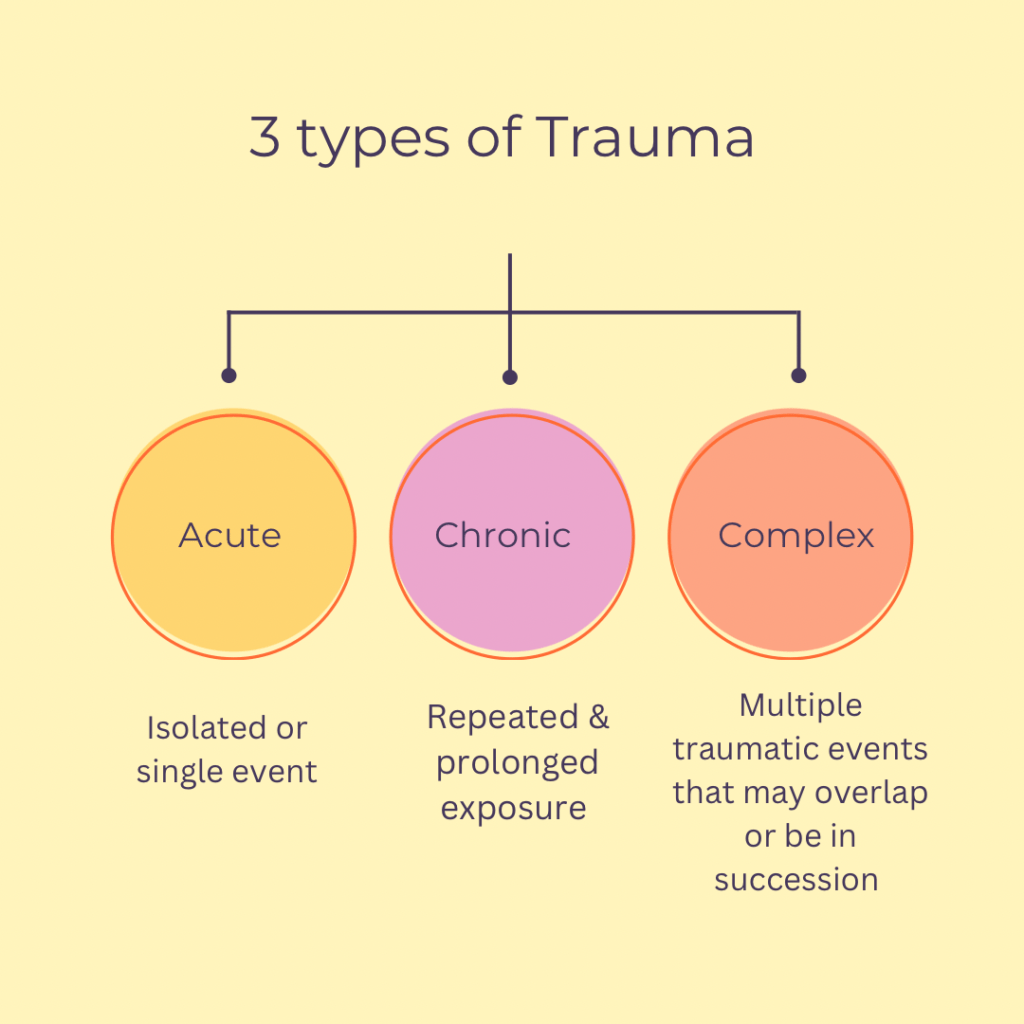
Trauma also comes in various types.

An individual can experience:

  1. Acute Trauma – this type of trauma occurs as the result of an isolated, terrifying incident where a person feels overwhelmed by a direct threat to their life or someone else’s and has feelings of intense helplessness and fear. Some examples where acute trauma may occur are: witnessing an act of violence, death of a loved one or seeing someone die, living through a traumatic situation like a car accident, house fire, natural disaster, etc.

2. Chronic Trauma – this type of trauma describes a situation where a person experiences many traumatic events over an extended period of time, such as in cases of repeated exposure to abuse, neglect, domestic violence, those who live in war zones or areas of severe political unrest. The repetitive nature of this type of trauma causes a person to develop significant loss of trust in other human beings, anxiety and fear for their own safety, guilt, shame and symptoms such as chronic anxiety, physical or mental illness, addiction and fatigue.

3. Complex Developmental Trauma – the third type of trauma is the one that is most important to understand in light of foster care. Developmental Trauma is diagnosed by four significant factors. First, it includes traumatic events early in a child’s life (the first five years). Secondly, it includes patterns of chronic, ongoing trauma. Thirdly, it involves maltreatment of some kind such as abuse or neglect and fourthly it includes the absence of a caregiver to protect or buffer the traumatic experience. Oftentimes, this trauma occurs at the hands of the very person the child should be able to rely on to protect and support them such as a parent or other trusted adult.

While all three types of trauma are certainly impactful and devastating, Complex Developmental Trauma often has long lasting and severe impacts that are very important to understand.

Photo by Lisa from Pexels on Pexels.com

When parenting a child who has experienced this type of trauma, it is essential to focus on helping the child feel connected and safe with their caregiver. This is no small feat. The child who has experienced complex developmental trauma will most likely experience developmental delays, cognitive deficits, physical and mental fragility and illness, challenging emotions and behaviours and resistance to both structure and nurture.

Many times, these symptoms of trauma look a lot like bad behaviour. If we have not taken the time to get curious about the ways children are behaving and responding, we risk causing further hurt to the very children we want to protect and care for.

Initially in our foster care journey, my husband and I had a very limited understanding of trauma and its impacts. As the years went by, we started realizing how small our “toolbox” was and we were noticing that some of the traditional parenting techniques we relied on were not having the effects we anticipated. Removing priviledges, time outs, consequences we felt fit the behaviour, punishments…they did not seem to sit the same with these kids. We knew that we needed a greater understanding and compassion for what was going on inside of these children’s minds and hearts. We wanted them to experience healing and connection.

I am so grateful that God gave us opportunities to learn more about how trauma impacts a child and what that meant for us as their caregivers.

More importantly, it’s changed the way that I view the world and the people around me.

Slowly, I am learning to ask,

“What happened to you?”

Instead of,

“What is wrong with you?”

Dr. Bruce Perry and Oprah Winfrey wrote a beautiful book titled What Happened to You? In it, they explore this exact shift and what it might do to promote healing in our society if we all learned to ask this question.

I am also learning how to be curious instead of furious about challenging behaviours and responses – both with my children and myself! I am learning how to put on a lens that assumes this person can’t yet instead of won’t. This mindset assumes that people are doing the best they can with what they have and that skills can be taught through care and connection.

Dr. Ross Greene has become popular among child phsychologists and educators with his Reframe the Behaviour model. I have this infographic posted on my fridge because I need the reminder every single day.

“Kids do well if they can.” – Ross Greene

No child (or adult) sets themselves up to fail. We all want to thrive and succeed, but sometimes there are expectations, requirements or assumptions placed upon us that are not appropriate for our mental, emotional or cognitive capacity.

“See a child differently, you see a different child.”

– Dr. Stuart Shanker

So why all the talk about trauma?

Understanding trauma helps us to move from simply feeling compassion to truly developing the skills needed to care well for those who have lived through horrific experiences.

Photo by Pavel Danilyuk on Pexels.com

Maya Angelou was a poet and civil rights activist. She once said,

“Do the best you can until you know better. Then when you know better, do better.”

 In chapter 3 of his letter, Paul writes to the Colossian believers about their new identity in Christ.

“Put on then, as God’s chosen ones, holy and beloved, compassionate hearts, kindness, humility, meekness, and patience, bearing with one another and, if one has a complaint against another, forgiving each other; as the Lord has forgiven you, so you also must forgive. And above all these put on love, which binds everything together in perfect harmony. And let the peace of Christ rule in your hearts.”

Compassion and kindness.

Humility.

Meekness – strength under control.

Patience and forgiveness.

These are the characteristics that are to mark the believer.

Similiarly, to the Phillipians, Paul encourages them,

“Do nothing from selfish ambition or conceit, but in humility count others more significant than yourselves. Let each of you look not only to his own interests, but also to the interests of others.”

If there is anything I have learned in this foster care journey, it is that humility is the most important ingredient.

It takes humility to consider new perspectives, to lay aside preconcieved ideas and to admit when my repetoire is limited and lacking.

Neuroscientific research is exploding with new information about how our brains and bodies are designed to respond to the world around us. Everything I have learned about trauma is consistent with what the Bible teaches about how we were created and who we were created for.

There is so much hope and healing available, but it begins with a deep understanding and acknowledgment of brokenness.

I am passionate in helping everyone everywhere, but especially those who are Christians, understand more about trauma and how it impacts those who experience it because I believe that this is the way that Jesus would have us live and walk in the world.

Love God.

Love people.

This is why trauma matters.

-AF

Statistics

May is foster care awareness month.

My goal this month is to post in some medium on a daily basis to create greater awareness of needs, dispel some myths and encourage those impacted by foster care.

I’d be so delighted if you are able to join me this month. Additionally, if anything I say sparks curiosity, resonates with you or inspires you, please take the time to share that in some way with someone in your life.

It takes a community to care, to create lasting change and to build support around the vulnerable. It all begins with a conversation.

May 2: The Statistics

“Without knowledge, action is useless; and knowledge without action is futile.”

-Abu Bakr

According to the Ontario Association of Children’s Aid Societies, in 2024 there were an average of 8200 children and youth in care in Ontario each month. Over half (56%) of those were youths aged *16-22+.

Every region in Ontario is in desperate need of more foster homes in order to be able to place these children in safe, loving environments while the agency works with the caregivers to try to increase safety and well being. Many children are needing to be moved far from their home, family, school and services to be placed in a foster home. This makes the process of supporting and reunifying the family unit much more challenging. It also increases the traumatic impact on the child and the losses they incur during that separation process.

Poidata states that there are 4 841 churches in Ontario. When we compare this to the average 8200 children in care each month, this means that if each church in Ontario cared for just two children in care, there would be more than enough homes for the 1% of children who are removed from their families and in need of a safe place to stay.

So how do these families become connected to a child welfare agency?

Most of these families will get connected throuh referrals from concerned individuals such as teachers, neighbours, family members or friends. Some referrals are made by police or other public service agencies.

Everyone in Ontario, including general citizens and people who work closely with children, are required by law to report suspected child abuse or neglect of a child under the age of 16 to your local child welfare agency. While this may feel like a difficult decision, it’s always best to ere on the side of caution and allow professionals to decide whether or not your concerns are in need of further investigation.

More than 125 000 calls or referrals requesting family assistance were made in Ontario in the 2023-2024 fiscal year.

Out of these, 63 000 (just under half) required a full child protection investigation. The rest of these referrals did not require a full investigation and/or were connected with community resources that would further equip and proactively offer protection.

Photo by Photo By: Kaboompics.com on Pexels.com

When a full investigation was completed,

  • 97% resulted in children and youth remaining at home with their families while agencies work alongside to offer support and buffering care
  • A mere 2% of those investigations resulted in a child needing to be removed from their home and placed within the home of a family member, friend, neighbour, etc.
  • Only 1% of those investigations resulted in a child or youth being removed from their home and placed into foster care

Child Welfare systems are overwhelmed, undersupported, working with minimal resources and surrounded by legal “red tape” that governs their ability to provide services and protection to children and families. Despite that, they are working diligently to provide support to families that will enable them to keep children at home with their parents. This might look like finding funding, respite or educational opportunities for caregivers. It may also include assistance for parents in navigating challenging systems and connecting them with community supports. It might look like offering 1:1 parenting coaching, group parenting classes or connecting parents with services needed.

Child Protection Workers work hard to find creative, supportive and respectful ways to support struggling families.

Contrary to popular opinion, children are not taken from families lightly and child welfare agencies certainly are not interested in removing children without proof of significant danger and only after many attempts have been made to remediate the situation in other ways.

So what can we do about these statistics?

  1. Pray – Offering support to hurting, vulnerable and broken families requires much grace and wisdom. Pray for the families, youth and children represented by these statistics. Pray for the social workers and agencies on the front lines attempting to offer support to these families. Pray for families currently offering care to these children and pray that more families will step into the gap to fill these needs. Pray for churches to get involved – that as Jesus followers we would be willing to bridge the gap between child welfare agencies and Christians who are eager to care. Pray for the hands and feet of Jesus to be evident in Ontario’s foster care system in undeniable ways.

35 For I was hungry and you gave me food, I was thirsty and you gave me drink, I was a stranger and you welcomed me, 36 I was naked and you clothed me, I was sick and you visited me, I was in prison and you came to me.’ 37 Then the righteous will answer him, saying, ‘Lord, when did we see you hungry and feed you, or thirsty and give you drink? 38 And when did we see you a stranger and welcome you, or naked and clothe you? 39 And when did we see you sick or in prison and visit you?’ 40 And the King will answer them, ‘Truly, I say to you, as you did it to one of the least of these my brothers,[a] you did it to me.’”

Matthew 25:35-40

2. Start the Conversation – Whether this is at your dinner table tonight, in your weekly small group, your workplace or with your neighbours…start a conversation that is both factual and compassionate. The way we speak about foster care and the people within this system matters. Talk to your spouse about how you might be able to get involved as a family. Talk to your teens about the reality that many of their peers are living in. Talk to your kids about why a child at school might be having a hard time and how not all families look the same. Talk to the people in your church about how you might be able to offer care to those in your community who are struggling. Talk to foster, adoptive, kinship and customary care families about their experiences and ask how you might be able to offer support to them.

Above all, love each other deeply, because love covers over a multitude of sins.”

-1 Peter 4:8

3. Act – Lastly, however you are prompted by the Spirit – take action. Make a phone call to your local foster care agency or a family you know who is providing foster care. Make a plan for how you are going to support a foster family or how you might be able to help support a struggling family. Continue to educate yourself about how foster care is impacting your community and what efforts are being made to alleviate risk factors.

Thank you for caring!

-AF

*Did you know that child welfare agencies provide supports to youth “aging out” of the system up to the age of 22 and even older? There are myriads of ways you can support these young adults in your community.

Some practical needs include: housing in the form of an extra room to rent out to a youth attempting independence or lacking family support, providing transportation, mentorship opportunities, etc.

Think of all the things you didn’t know at age 18, 20 or 22. College applications, healthcare, employment opportunities…all of these are huge and scary realities that a teen emerging from foster care or a dysfunctional family environment may need support navigating.

Let’s Begin With Loss

May is foster care awareness month.

My goal this month is to post in some medium on a daily basis to create greater awareness of needs, dispel some myths and encourage those impacted by foster care.

I’d be so delighted if you are able to join me this month. Additionally, if anything I say sparks curiosity, resonates with you or inspires you, please take the time to share that in some way with someone in your life.

It takes a community to care, to create lasting change and to build support around the vulnerable. It all begins with a conversation.

Photo by Alexander Krivitskiy on Pexels.com

May 1: Let’s Begin With Loss

Every single child who enters the foster care system has experienced significant loss. By this I mean they have experienced gut-wrenching, world shifting losses that will forever change how they view the world. We call this kind of loss: trauma.

Typically, these losses include:

  • Loss of a parent or other primary caregiver through separation or death
  • Loss of extended family members and friends
  • Loss of familiar environments such as their school, daycare, favourite park, neighbourhood, etc
  • Loss of toys and items – that stuffie he always sleeps with or the markers Grandma gave her for her birthday are likely to have been left behind
  • Loss of safety – children are only ever removed from homes because they are in need of safety and protection in some form
  • Loss of comfort – whatever is normal to us is what we find comfortable. While a blanket reeking of marijuana may not provide comfort to you, for a small child who associates this smell with “home”, replacing that blanket or washing it with bleach to remove the scent you find disgusting will be a loss.
  • Loss of control – children almost always enter foster care against their will.

These kinds of losses accumulate in staggering realities when a child is removed from their home and family and placed into foster care. This choice is never made lightly. It’s important to remember why this move is deemed a last resort intervention for families who are struggling and the impacts this intervention will have on the family unit.

In the face of such significant losses, most children and their parents will experience feelings of grief, anger, hopelessness and shame.

But this is not what most people first think of when they see a child in the care of a foster family.

“Adoption (or foster care) loss is the only trauma in the world where the victims are expected by the whole of society to be grateful.”

-The Reverend Keith C. Griffith

This quote popped up on my social media feed recently and snagged my attention long enough for me to wince. I feel this. As a foster mom who has loved the children that enter my home deeply, advocated intentionally for their needs, been proactive about connecting with biological parents in healthy ways and supporting reunification…I still fall into the trap of believing that these children and families I care for should be grateful to me; that they owe me something.

This theory is reinforced through comments, conversations and stories that celebrate foster parents as heroic, “saint-like” humans with special giftings to care and serve well. Simultaneously, biological families are generally viewed with thinly veiled disdain and suspicion.

I cannot count the times I have shared that I am a foster parent and been told,

“Good for you!”

“You are amazing!”

“I could never do that.”

“They are so lucky to have you.”

I’m a human, and sometimes these comments feel really good! However, that feeling of satisfaction or even pride is always followed by a sense of sadness, discouragement and a feeling of being misunderstood. While I do understand these comments are made with the best of intentions, they all play skillfully into this false perception that foster parents are uniquely equipped humans who have chosen to sacrifice greatly for the good of others – others being children and families in need of our rescue.

So what’s the problem?

The problem is that when people are hurting, they don’t need someone to rescue them. They need someone to care. And almost anyone can care!

Until we can see foster care as a way to care instead of a way to rescue, we’re going to keep getting it wrong and having unrealistic expectations.

The mother with addiction issues needs someone to care enough to ask the question, “What is it in life that feels so big that you’re reaching for these negative coping tools right now?”

The father with domestic violence charges needs someone to care. Someone to say, “I get it. I never knew I could feel rage toward someone I loved until I became a parent. I know you love your kids. Let’s figure out how to break the patterns of anger and violence so your kids can feel safe with you.”

The toddler who has just been placed into a stranger’s home, far from everything familiar in life, needs someone to care. He needs someone to be patient as he screams through bathtime, bedtime and storytime.

The grandmother who is “abandoning” her grandchildren needs someone to care. She needs someone to come alongside and say, “How can I help? This is a lot that you’re carrying, and I can see how exhausted you are. Your needs matter too. “

The adolescent who has just entered foster care against her will needs someone to care; someone to give her choices about as many things as possible as she navigates this new life that she did not choose or want or ask for. She needs someone to be curious about the coping tools she’s accumulated to survive in a challenging home environment. She needs someone who is willing to show up again and again and again and again.

And all these people need someone who is willing to care without expecting gratitude in return.

I have never met a parent who does not genuinely love their child and want to do better, no matter what they have done. I have also never met a parent who gets it all right 100% of the time.

Almost all of the parents of children entering the foster care system are people who have experienced trauma. They are coping with life in the only ways they know how…just like you and I. Many of them grew up in foster care themselves or in abusive or neglectful home environments where they did not get a chance to learn how to care for children or themselves as caregivers with a healthy balance of structure and nurture.

Many of them are isolated, struggling with mental illness, have toxic relationships and lack financial security.

What would it look like to change our understanding of foster care to include more empathy surrounding the losses involved?

My hypothesis is this:

Understanding the losses that children experience when they enter the foster care system would lead to communities who are:

  • more empathetic toward children in foster care and their biological families
  • more proactive about suppporting struggling families
  • curious about behaviors of both children and adults within the system who have experienced loss
  • dedicated to preventing the separation of families and supporting the reunification of families whenever possible

One more thought to leave you with.

What is something in your life that you do not like and cannot change?

What emotions, behaviors and coping tools come to the surface as you process that reality?

What might it look like to support someone involved with the foster care system today with empathy, curiosity and care?

-AF

Finding my Voice

It’s been a long time.

I’ve been quiet here for a couple of years now. There have been too many things to say and yet so little ability to articulate those experiences and thoughts, so I froze.

Grief, trauma and broken relationships have a way of stealing a person’s voice – hiding them under a heavy cloak of fear, disillusionment and shame.

And then there is the exhaustion that comes and overtakes and sucks up every last ounce of your resources. Your brain and body kick into conservation mode, desperate to reserve enough energy to make it through the day.

My own story is so intertwined with others’ stories that it feels nearly impossible to figure out how to talk about what is going on inside of me and in my life without revealing too much of someone else’s story.

But I’ll try.

The hard truth is that we – my family and I -are not ok. We haven’t been ok for quite some time now. It feels uncomfortable to just leave that sitting there…but that’s exactly what I’m going to do.

Opening up this page again to start writing is me choosing brave and burying the shame and fear that would like to keep me silent.

I know that I’m not alone. There are more of you out there who are not ok and there is no light at the end of the tunnel in view to run toward.

It’s ok to admit that.

It’s important to admit that.

The fixer in me desperately wants to rush toward the bow tie of this post – to come up with some silver lining to cling to. I’m not denying that the potential for that is here, but I’m saying maybe that’s not what is needed right now.

It has been said of grief, of writing and of art,

“It takes as long as it takes.”

Does anyone else feel a surge of irritation at those words?

Does anyone else also feel a deep and pulsing calm?

Breathe in.

Breathe out.

Drop your shoulders.

“It takes as long as it takes.”

We create these timelines in our minds; goals, expectations and hope are all pinned to that progressive, horizontal line.

But then life comes and sends us spiralling off that line and into some other reality that we have not considered. There doesn’t seem to be any sort of way to measure progress over here.

I used to think that the word faithfulness described an outcome, with positive data and results that I could meaure and analyze and replicate.

I think now that faithfulness describes a state of being. It involves someone practising deep presence and abiding fully in the harsh, delightful, mundane realities of life. It is less about something you do, and more about who you are.

The strength of faithfulness is in our understanding of our identity. Faithfulness is born out of a knowledge that we are deeply, unconditionally loved by God.

It’s almost impossible to measure.

When conducting a science experiment, it’s important to make sure that only a singular variable exists within the experiment. Every component must be identical except for the one that you are planning to change. In this way, we are able to determine whether the impacts observed are truly results of the one component that has shifted.

Our lives as Believers can be explained in similiar language. When we are born again into a saving faith, there is only One component that truly shifts. But suddenly, our identity has changed. With the covering of our sins by the completed work of Jesus, we become heirs to an entirely new existence and reality. We are set free.

However, our physical reality here on earth remains the same. We still exist in a very physical, broken and sin filled world. We still live within the parameters of our own humanity and others’ sinful choices. Every day we wade through the mess of a world that is tainted and decomposing around us. We live inside of human bodies that betray us, constrict us and limit us.

Sanctification is the process in which Jesus takes our surrendered hearts and changes them from one degree of glory to the next. It is the proccess of our minds and hearts being renewed day by day. It is the gradual, patient work of healing and forming new rhythms and choosing gratitude. It includes the physical neurological work of rewiring our brains by the slow, intentional shifting of our daily choices.

When Jesus saves us, He doesn’t save us from the world and all it’s difficulties, but instead promises that our reality within that world is going to change.

We will be changed.

Faithfulness, the way our Father describes it, is simply relationship. It is acknowledging that now we exist within the reality of Emmanuel – God with us. In the middle of our same broken, flawed, sin tainted reality we suddenly have a new Presence and Light. Choosing to cast our weary selves upon that Presence is where faithfulness is found and where the glory of God is revealed to us and others.

Advent came and went a few months ago, and there doesn’t seem to be a break in sight.

No break in the pressing daily realities of parenting my children,

No break in the seemingly steady waves of grief and loss that continue to wash up on our shores,

No break in the hard work of fighting for healing and justice and services,

No break in the layers of trauma that need to be stripped away so that those I love most can experience love and joy.

But Emmanuel – God with us – brings Peace.

Knowing that I am not alone and that He is all about changing me from the inside out helps me fix my eyes on Him instead of our circumstances.

This thing I’m wrestling to the ground might never change.

But I will change – He will make sure of that.

This hard might never get easier.

But I will see it differently – He has promised growth and vitality.

This might be only the beginnning of a very hard, long season.

But I will be granted endurance for one day at a time to trudge through it.

“As we consider our family’s story, our hope is not in a happily ever after, but in knowing the Author.” -Jamie Finn

-AF

10 Things to Know Before Becoming a Foster Parent

May 5
There are a few important things to know before you consider becoming a foster parent.

  1. This is not about you.  Foster care is about bringing your family to a child and their family, for a season that is not determined by your own desires or even your ability to provide for this child.  Your wishes will not always be granted.  Your advice will not always be followed.  Your opinion will not always be asked.  Your feelings, your family, your schedule and your time will not always be considered.  Entering this world means that you are agreeing to put this child’s needs above your own and that you are committing to working alongside a government agency that will ultimately have control over this child’s life. Sometimes it will feel like they control your life as well. 
  2. Foster care usually does not end in adoption.  While children will sometimes need a new permanent family to care for them, that is the result of much more than just a child being placed in foster care.  If you are committing to foster care, it’s important to realize that this will most likely end in you saying goodbye to a child you deeply love and care for.  The goal is for biological parents to receive the support they need to raise their children.  As foster parents you need to be ready to focus your energy and support in that direction, not in building your family.  I still have to preach this to myself every single time a child enters my home and leaves my home. It is so hard to see past the complicated aspects of each situation to the broader picture. As a society we need to be focused on equipping parents to parent, not on removing children from their families and placing them in new ones. Adoption brings it’s own unique challenges. There will never be enough adoptive homes for all the children living in vulnerable situations, but if we can equip parents to parent intuitively and responsibly we are starting to heal the huge tear in the walls of the family structure.     
  3. It will hurt.  Saying goodbye will hurt.  Playing the part of the parent who stands in the gap will feel uncomfortable.  Watching a child go through painful transitions will leave you feeling helpless.  Hearing your child’s story will make you feel anger, pain and fear like you’ve never felt before.  Loving another parent’s child will hurt.  What you will quickly discover, however, is that your hurt quickly pales in comparison to the hurt experienced by your foster child and their biological family.  Their hurt will become your motivation to love, protect, honor and keep doing the next thing.
  4. Trauma matters.  Children who enter your home through foster care have always experienced trauma of some kind and will need to be parented differently as a result of this.  You need to understand how trauma, even prenatal trauma,  impacts a child’s neurological, physical, emotional and spiritual health.  This is crucial.  It cannot be a side thing.  This knowledge of trauma must be the foundation of your parenting philosophy with these children.  So do the research, find the facts and adjust your expectations accordingly.
  5. It will take time to feel like you love them.  Sure, you may get that adrenaline rush of love and protection and passion when they first enter your arms, your home, your heart.  But it will quickly be followed by a feeling of fear and dismay and ‘what have I done?’  This child will be a stranger to you for the first while, and that is okay.  You will feel like a babysitter before you feel like a parent.  Then one day you will wake up and realize you would die for this child and that you cannot remember what it was like without them in your life.  Don’t beat yourself up when you struggle to attach. They are dealing with the same challenge. Remember that and let it lead you toward compassionate responses.
  6. Know why you’re here.  Some people will love you and others will hate you for being involved in this system.  The opinions will come, often when you least expect and from those you did not ask.  They will have stories, warnings, accolades and flattery to offer you.  Learn to let them all slide off your back; both the love and the hate.  You know you’re not a hero and you know you’re not a villain.  The admiration of those looking in or the hate of those scarred by it are all irrelevant when it comes to you and your story.  You have made this decision based on many factors and their opinions are not one of them.  Know why you are in this and remind yourself of it often.
  7. You will never really be ready.  You won’t ever really be prepared to bring a stranger into your home or have a social worker tell you how to parent.  You will never really be ready to meet your child’s biological parent and calmly face their anger and hurt.  You will never really be ready to have your home, your family, your life and your past dissected by someone you hardly know to try to gain ‘approval’ from a system you barely understand and definitely don’t trust.  You will never really be ready to be spit on, kicked, screamed at and falsely accused.  You will never really be ready to hear the hard parts of their stories or find the words to explain heartbreak, abandonment, shame and abuse.  You will never really be ready to say goodbye to a child you have loved and fought for and protected.  Please don’t wait to be ready, and don’t be surprised when every last thing about foster care leaves you feeling like the breath just got snatched from your lungs.  Believe it or not, this is normal. 
  8. You don’t have to ride the roller coaster.  There will be highs and lows, promises and demands, fears and failures.  These emotions, words and desires can send you spiraling through loops, soaring on hope and crashing in despair.  Know that you do not have to take that ride!  You can be wise, discerning and prayerful.  You can hold your heart close and your words in check.  You can take one day at a time and refuse to make promises you can’t keep.  This is not being cynical, this is guarding your heart in the best of ways.  Loving a child in foster care well requires a deep commitment to truth and a resolve to take only the step right in front of you.  It is so tempting to run ahead, join the blame and shame game or throw your hands up in frustration.  Stay the course, be loyally in the present and keep your heart safely moored to the One who can steady you.
  9. You will need support.  This might be your church family, your parents, your neighbours or your life group.  It might be therapists, teachers or doctors.  It doesn’t really matter who it is, it just matters that you have them.  People who see you and love both you and the children you bring into your home, unconditionally.  People who will babysit, listen to your frustrations and fears, encourage you to keep going and point out the flaws in your perspective.  People who will tell you when to take a break and support you when you say yes anyway.  You are going to need people you can share the hard stuff with and know that it’s not going any further than their ears.  When the stories are hard, the day was long and the court dates are looming…you need someone to call.  Find your people.  Not only will you need them, but the children you bring into your home will be richly blessed by having a community around them.        
  10. There will be easy days. I know, after all that I just said this feels a little odd and unexpected. But it’s true. There will be days you forget that child is not your biological child or that they will one day leave your home. There will be days when the routines feel seamless and the love comes easy and it feels like a match made in heaven. There will be days they are regulated and calm and you can parent them the way you would parent a biological child. There will be days you look down and feel a love so deep it overwhelms you. There will be days that feel normal and predictable. These might be common or they might be that one in a million feeling, depending on the child and the circumstances. But they will come, I promise.          

Are you ready to say yes to this adventure of love and loss and grace? I would love to walk alongside you. Send me a message or email. It is hard but so worth it!

~AF

Finding Hope in Foster Care

“I feel like the wins are just so hard to come by,” I said to her, my voice breaking a bit on the grief that flooded through me with those words. She nodded, heart in her eyes. I didn’t have to explain this to her. She knows all too well.

I know why I do this-foster care, that is.

I have a foundation that is rock solid…mostly.

But when the goodbyes pile up, disappointment and disillusionment launch right into that vulnerable cavern and nest deep in my heart.

What is the point?

The system is impossibly broken.

No one will listen to us.

Ultimately people who have never met this child will make life-altering decisions for all of us. The child, their biological family, me, my husband and even my children.

It’s so unfair.

Does what I do make any difference?

We tried to protect her, but now our hands are tied. We make the hard call, and then we sit back in the impossibly sad reality of her story. We sit as helpless bystanders on the edge of our seats watching her fall, fall, fall. One by one the safeguards we’ve put in place fall away and she’s left terrifyingly vulnerable to her own devices and coping mechanisms. Our limited capacity has never felt more like a betrayal than now.

I’ve mothered him for two years, nurturing him through the chaos and confusion and achingly slow progress of healing and advocating for all of his needs, but now suddenly he is pulled from under my wings. Nobody asks me if this is best. Everyone knows it isn’t. Nobody says the words that keep me awake late at night…what if he will not be ok? When the time comes, it is me who has to deliver the heartbreaking truth and hold his small body as he sobs into my chest. I feel emptier and more broken than I ever thought possible. I must become the betrayer. Over and over and over again as he begs not to go, for me not to leave. I really wanted to be his Mommy. I thought that I was. Who am I now to this child?

It’s only been a few weeks, but it’s been weeks of holding, holding, holding. Rocking, singing, bathing and delighting in every perfect feature of his personhood. It was us who walked the hospital hallways cradling his tense little body tight. It was us who brought him into his first home and watched every little twitch and grimace he made as he slept in the safe warmth of our tiny nursery. His first Christmas, first smile, first full night of sleep, first tummy ache, first walk, first toy…the firsts could go on and on. The goodbye is quick and devastating and sharp enough to take my breath away. I stumble through blinding tears out the door without him. Forever.

All of these and more pile up and I relive the pain of each one every time we say goodbye. Can I keep doing this? Justice and truth feel so far from this realm. Am I the good guy or the bad guy in this story? Nothing feels clear.

“You are not the story, you are only a part of the story.”

The words resonate deep and I breathe in the calm and peace they bring.

“Your season of service and faithfulness and pouring out may be over, but He is not done yet. He will not leave her or forsake her. His promises are as true today as they have always been.”

With truth, comes hope.

Hope – that the model of unconditional love, grace and mutual respect she has witnessed in our home will guide her toward healthy relationships, safe environments and truth.

Hope – that the leaps and bounds of development he made while in our care will carry him on into a bright future of literacy, independence and ability to communicate with the world around him.

Hope – that the hours and hours of gentle touches and cradling and singing and praying over his sweet, tiny head will bear the fruits of attachment and nourishment and health.

Hope – that the advocating I have done will set him and his new family up for succcess, despite the odds.

Hope – that the gospel will have found it’s root deep within her heart and that His word will not return void, but will instead bear a harvest that is glorious in due season.

#Isaiah 55:11

Hope – that the speech therapy and hours and hours of time spent side by side playing on the floor will give him a foundation of language that will enable him to communicate and to be seen and known for the beautiful boy that he is.

Hope – that this brief time in foster care will alleviate the stress in her birth family and that she will grow up in the care of her biological mom, unaware of the fleeting season she was ours.

Hope – that even in the saying of our no, our hardest no, that she would understand a love that is higher and deeper and wider than anything that she can imagine.

Hope – that the skills we have developed and the growth that He has procured in our hearts will flood forward and benefit the ones we have and the ones to come.

Hope – that the placing of his tiny life into the gentle arms of dear family members and friends, will carry him forward into a future where he will be loved and always wanted.

Hope – that the telling of their stories will bury the shame and give them confidence to embrace all that is theirs.

Hope – that our resting will bring strength and energy to bring into a new season before us.

Hope – that the hours and hours of training and rewiring our brains to think, act, speak and see differently will make us better, gentler, more skilled parents to the children in our home now and in the future.

Hope – that allowing the grief to swallow us at times will refine our hearts to love more purely and unselfishly and without thought of all that is to be sacrificed.

Hope – that exposure to these children and their families will bring our permanent members appreciation for what is theirs, compassion for those around them, life skills and character.

Hope – that in our greatest moments of weakness His strength will be magnified and made perfect.

#2 Corinthians 12:9

Hope – that He who began a good work will be faithful to complete it, if not in this time span of our lives then in the broader, grander, incomprehendable vastness of the story that is His and His alone.

#Philipians 1:6

“I know what I’m doing. I have it all planned out—plans to take care of you, not abandon you, plans to give you the future you hope for.”

#Jeremiah 29:11

-AF

10 Ways To Prepare for a New Foster Placement

Preparing for a new child to enter your home through foster care is both exciting and apprehensive.

Usually we have less than twenty-four hours to get everything ready before the child is walking through the front door.

There are ten things that I try to do when I’m preparing for a new child to arrive.

  1. Prepare bedroom.  

    This is usually the first thing on my list as it’s the most important.  When the social worker arrives with the new child, they will both want to see where they will be sleeping and make sure there is a place for their things.  I like to keep a variety of bedding options on hand to pull out so I can accommodate boys or girls of the age range we typically foster.  I prepare the bed, do a quick tidy of the room and make sure there is plenty of room for clothing, diapers, etc.  If it’s an older child it’s nice to make sure there’s an empty hook in the hall closet for coats and backpack, a drawer or toothbrush holder in the bathroom and space in the bedroom for things they don’t want to share.

  2. Make a list of questions to ask the social worker upon arrival.  

    I am in the process of putting together a binder and printouts that I can use each time so I don’t have to rethink this one every time, but before they arrive I like to jot down any questions I have, dates to share and reminders for myself to bring up during our conversation.  The important ones are questions about routines for the child, medical concerns, contact info of the placing worker, and what to expect for access with biological family.  All of this should have been shared already over the phone or be included in the folder given at the time of placement but it never hurts to cover the main things twice.

  3. Pull out appropriate clothes, toys, equipment, etc.  

    I have a collection of baby equipment, clothes and toys in storage that are not currently being used.  When a new child is on their way I like to pull out any bins of clothing I think might fit and any equipment such as baby carriers, swings, rockers, etc I might want to use.  It’s nice to know what I have in case a child arrives with very little clothing, toys, etc.  This also helps me know what might need to go on my shopping list.

  4. Grocery shopping.

    The last thing you’re going to want to do within the first few days of a new placement is run to the store for food, so if there’s time I scope out the fridge and sneak in a shopping trip before the child’s arrival.  Included on that grocery list will be easy, kid friendly foods that most children will find comforting and familiar such as Kraft Dinner, chicken fingers, french fries and pizza.  I also like to make sure I have diapers, wipes, formula, toothbrushes, etc.  Some of these I keep on hand regularly.

  5. Laundry.  

    I like to be able to focus on settling in the new arrival without having to worry about us all having clothes to wear, so I often throw in a load or two of laundry as I’m waiting.

  6. Cook dinner.  

    Whether the child is expected to arrive first thing in the morning or nearly bedtime, I try to think ahead to the next couple meals and make sure I have some easy options available that won’t take too much time or attention on my part.

  7. Simplify my calendar.  

    In between placements, I try to keep going on as normal and planning life, even though I know those plans could be cancelled at any minute.  When I know for sure a new child is arriving, I always take a look at the next few weeks of my calendar and see if there’s anything that needs to be, or could be, eliminated.  This is also a good time to make sure there are no appointments, family plans, etc that you are going to require respite care, babysitting or special permission to take the child along for.  It’s good to bring those things up sooner rather than later, even though the child may have already left your home by the time you reach that date.

  8. Clean.  

    Whether it’s the bathrooms, bedrooms, floors or the fridge…if there’s a corner that has been bothering me for the last little while I try to get it cleaned before the child arrives as there’s no guarantee when the next opportunity might be!  Truthfully if I get to this one, it probably means the arrival is taking longer than expected and I’m having trouble waiting patiently!  🙂

  9. Take a shower and wash my hair.

    Particularly if there is a baby or toddler coming I try to get this done as it can be very difficult during the first couple days of getting a little one settled.

  10. Nap.

    Okay, so we all know this one is usually unrealistic.  Who has time to nap, especially while getting ready to welcome a new little person into your home!  Even if I do manage to lie down, my mind is usually too busy to be able to actually sleep.  It would, however, be a really great choice if you were able to do it!  Especially if you are about to bring a baby into your home.  Even older children will rarely sleep well the first week in a new home so bank up if you can!


And that’s it!

My top ten “Get Ready for a New Placement” goals.

What about you?

Anything you like to get done between the phone ringing and the front door opening?

I’d love to hear them!

AF