
If you’ve been paying attention to the world of foster care and adoption and helping vulnerable demographics, you’ll have been hearing the word TRAUMA thrown around a lot.

You might be wondering…
Why all the talk about trauma?
What does trauma have to do with foster care?
What exactly do we mean when we say someone has experienced trauma?
Let’s start with a definition:
Trauma: an event or experience that overwhelms a person’s capacity to cope.
This definition of trauma is purposely vague because we understand better than ever after the last decade of neuroscientific research findings that trauma is defined not just by the bare facts but also by how our body processes and encodes those experiences internally.
I like to think about it this way. Trauma happens when we experience too much for too long with too little support.

Trauma can happen to anyone anywhere.
Two people can live through the same experience and emerge with very different perspectives and affects depending on variables such as risk factors, developmental maturity, genetic predisposition and generational experiences.
While one child living through a war or dysfunctional family environment may experience trauma, another may not experience the same degree of impacts due to age, developmental ability or level of support they receive through their experience. This is why we sometimes see siblings manifest very differently despite having very similar looking experiences. For example, a younger child who is more dependent on an abusive or neglectful caregiver may manifest more dramatic symptoms than an older child who had opportunites to escape the daily reality through school or neighbours or friends.
It’s important to remember that we don’t get to define what has or has not been traumatic for another person. There are so many variables at play.
Trauma also comes in various types.
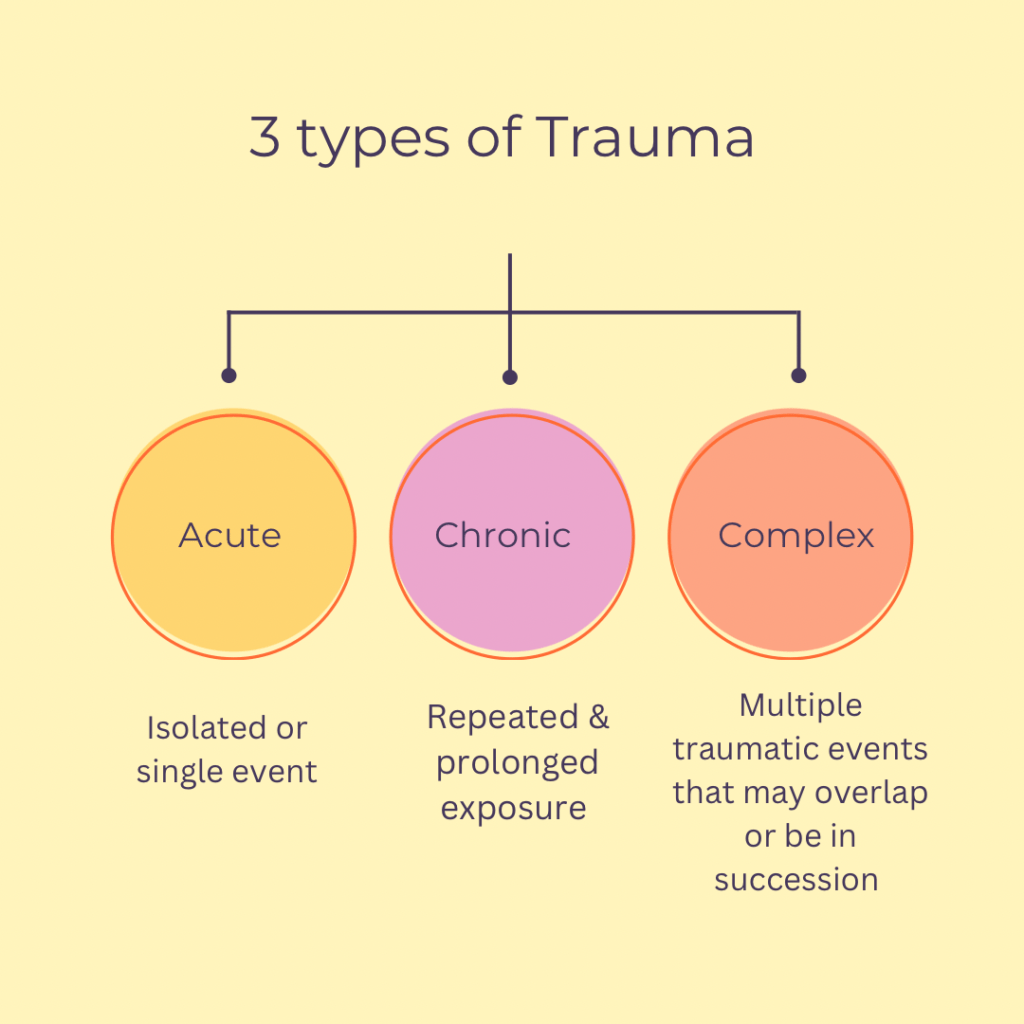
An individual can experience:
- Acute Trauma – this type of trauma occurs as the result of an isolated, terrifying incident where a person feels overwhelmed by a direct threat to their life or someone else’s and has feelings of intense helplessness and fear. Some examples where acute trauma may occur are: witnessing an act of violence, death of a loved one or seeing someone die, living through a traumatic situation like a car accident, house fire, natural disaster, etc.
2. Chronic Trauma – this type of trauma describes a situation where a person experiences many traumatic events over an extended period of time, such as in cases of repeated exposure to abuse, neglect, domestic violence, those who live in war zones or areas of severe political unrest. The repetitive nature of this type of trauma causes a person to develop significant loss of trust in other human beings, anxiety and fear for their own safety, guilt, shame and symptoms such as chronic anxiety, physical or mental illness, addiction and fatigue.
3. Complex Developmental Trauma – the third type of trauma is the one that is most important to understand in light of foster care. Developmental Trauma is diagnosed by four significant factors. First, it includes traumatic events early in a child’s life (the first five years). Secondly, it includes patterns of chronic, ongoing trauma. Thirdly, it involves maltreatment of some kind such as abuse or neglect and fourthly it includes the absence of a caregiver to protect or buffer the traumatic experience. Oftentimes, this trauma occurs at the hands of the very person the child should be able to rely on to protect and support them such as a parent or other trusted adult.
While all three types of trauma are certainly impactful and devastating, Complex Developmental Trauma often has long lasting and severe impacts that are very important to understand.

When parenting a child who has experienced this type of trauma, it is essential to focus on helping the child feel connected and safe with their caregiver. This is no small feat. The child who has experienced complex developmental trauma will most likely experience developmental delays, cognitive deficits, physical and mental fragility and illness, challenging emotions and behaviours and resistance to both structure and nurture.
Many times, these symptoms of trauma look a lot like bad behaviour. If we have not taken the time to get curious about the ways children are behaving and responding, we risk causing further hurt to the very children we want to protect and care for.
Initially in our foster care journey, my husband and I had a very limited understanding of trauma and its impacts. As the years went by, we started realizing how small our “toolbox” was and we were noticing that some of the traditional parenting techniques we relied on were not having the effects we anticipated. Removing priviledges, time outs, consequences we felt fit the behaviour, punishments…they did not seem to sit the same with these kids. We knew that we needed a greater understanding and compassion for what was going on inside of these children’s minds and hearts. We wanted them to experience healing and connection.
I am so grateful that God gave us opportunities to learn more about how trauma impacts a child and what that meant for us as their caregivers.
More importantly, it’s changed the way that I view the world and the people around me.
Slowly, I am learning to ask,
“What happened to you?”
Instead of,
“What is wrong with you?”
Dr. Bruce Perry and Oprah Winfrey wrote a beautiful book titled What Happened to You? In it, they explore this exact shift and what it might do to promote healing in our society if we all learned to ask this question.
I am also learning how to be curious instead of furious about challenging behaviours and responses – both with my children and myself! I am learning how to put on a lens that assumes this person can’t yet instead of won’t. This mindset assumes that people are doing the best they can with what they have and that skills can be taught through care and connection.
Dr. Ross Greene has become popular among child phsychologists and educators with his Reframe the Behaviour model. I have this infographic posted on my fridge because I need the reminder every single day.
“Kids do well if they can.” – Ross Greene

No child (or adult) sets themselves up to fail. We all want to thrive and succeed, but sometimes there are expectations, requirements or assumptions placed upon us that are not appropriate for our mental, emotional or cognitive capacity.
“See a child differently, you see a different child.”
– Dr. Stuart Shanker
So why all the talk about trauma?
Understanding trauma helps us to move from simply feeling compassion to truly developing the skills needed to care well for those who have lived through horrific experiences.

Maya Angelou was a poet and civil rights activist. She once said,
“Do the best you can until you know better. Then when you know better, do better.”
In chapter 3 of his letter, Paul writes to the Colossian believers about their new identity in Christ.
“Put on then, as God’s chosen ones, holy and beloved, compassionate hearts, kindness, humility, meekness, and patience, bearing with one another and, if one has a complaint against another, forgiving each other; as the Lord has forgiven you, so you also must forgive. And above all these put on love, which binds everything together in perfect harmony. And let the peace of Christ rule in your hearts.”
Compassion and kindness.
Humility.
Meekness – strength under control.
Patience and forgiveness.
These are the characteristics that are to mark the believer.
Similiarly, to the Phillipians, Paul encourages them,
“Do nothing from selfish ambition or conceit, but in humility count others more significant than yourselves. Let each of you look not only to his own interests, but also to the interests of others.”
If there is anything I have learned in this foster care journey, it is that humility is the most important ingredient.
It takes humility to consider new perspectives, to lay aside preconcieved ideas and to admit when my repetoire is limited and lacking.
Neuroscientific research is exploding with new information about how our brains and bodies are designed to respond to the world around us. Everything I have learned about trauma is consistent with what the Bible teaches about how we were created and who we were created for.
There is so much hope and healing available, but it begins with a deep understanding and acknowledgment of brokenness.
I am passionate in helping everyone everywhere, but especially those who are Christians, understand more about trauma and how it impacts those who experience it because I believe that this is the way that Jesus would have us live and walk in the world.
Love God.
Love people.
This is why trauma matters.
-AF


 Adoption, Mommyhood & the Rest